
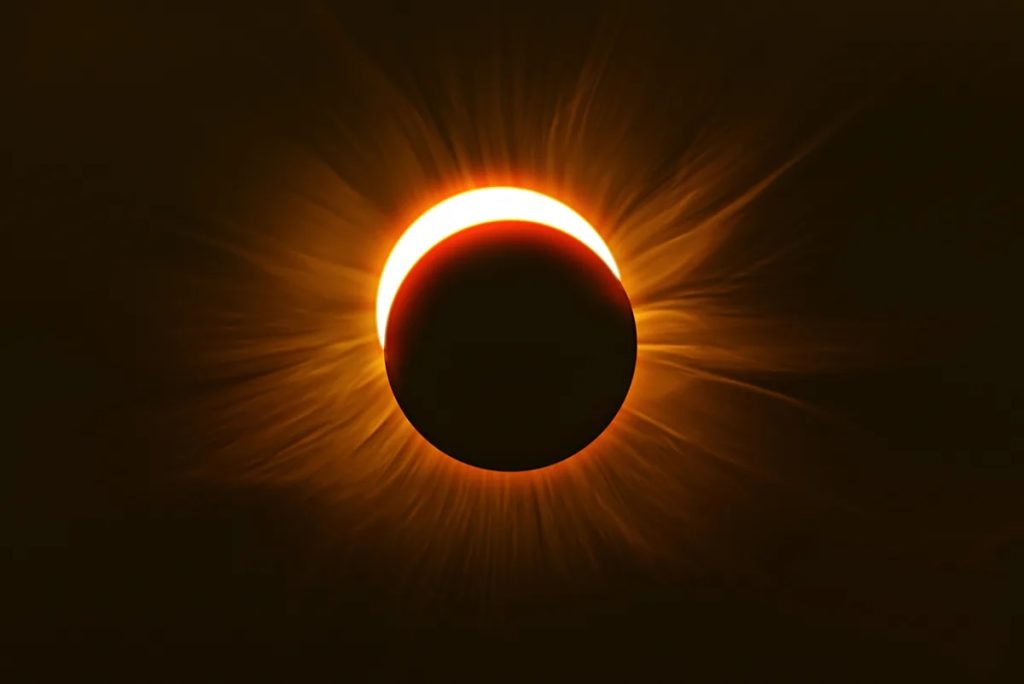
Mark your calendars for August 12, 2026. The universe is putting on a rare celestial double feature that promises a spectacular solar eclipse by day and a prolific shooting star display by night. Best of all, stargazers will not need any elaborate equipment to witness this historic “cosmic double whammy.”
DAYTIME: THE SHADOW OF THE MOON
The show begins in the af ternoon when the Moon passes directly between Earth and the Sun, temporarily blocking the solar disc. A total solar eclipse will carve a narrow “path of totality” across eastern Canada, Greenland, Iceland, Spain, and Mallorca, plunging daytime into an eerie twilight for a few minutes. Regions outside this narrow track—including the rest of Europe, Great Britain, Ireland, and the northeastern United States—will witness a dramatic partial eclipse. In the UK, major cities like Manchester and London will see over 90% of the Sun obscured, while Cork in Ireland will see up to 96% coverage. Because the event occurs in the late afternoon, observers in western Europe will enjoy the rare, breathtaking sight of a partially eclipsed Sun sinking into the western horizon. Editorial Warning: Looking directly at the Sun is incredibly dangerous. Certified solar eclipse glasses must be worn throughout the entire event, even during sunset. Alternatively, families can use indirect viewing methods, like projecting the shadow through a colander or tea strainer.
Also Read : Glow naturally with this easy mango face pack
NIGHTTIME: THE FIREBALLS OF PERSEID
As night falls, the excitement shifts to the dark sky. Earth will pass through the cosmic debris left behind by comet Swift-Tuttle, triggering the annual Perseid meteor shower. Known for producing “fireballs”—extra bright, dramatic meteors that leave glowing trails—the Perseids are widely considered one of the best meteor showers of the year. This year, the meteor shower will be exceptionally brilliant due to a fortunate cosmic coincidence: the eclipse happens during a New Moon. Because the Sun is directly behind the Moon, the Earth-facing side remains completely dark, eliminating all lunar glare. With the Moon setting alongside the Sun, the night sky will be perfectly dark, acting as a canvas for the faintest shooting stars.
HOW TO WATCH
Unlike the daytime eclipse, the nighttime meteor shower requires no filters or special gear. In fact, experts advise against using binoculars or telescopes, as they narrow your field of view. The meteors can streak across any part of the sky, making the naked eye the best tool for the job. To maximize the experience, observers should head to rural locations or local parks away from urban light pollution. As tronomers recommend giving your eyes at least 20 minutes to adjust to the pitch darkness. Avoid looking at mobile phones, and use a red-light torch if navigation is needed, as red light preserves night vision. Whether you catch the daytime shadow or the midnight streaks, August 12 is promising a celestial spectacular. Sometimes, the universe is truly good to us.
Orissa POST – Odisha’s No.1 English Daily