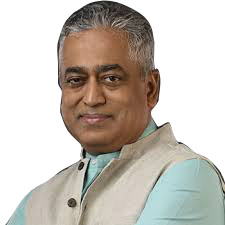
By Rajdeep Sardesai
The ‘shirtless’ Youth Congress protest at the AI summit in Delhi has produced the kind of reactions that now arrive almost by reflex. Outrage. Mockery. Moral grandstanding. Within minutes, social media and hyper-ventilating prime time shows playing the visuals in a loop had delivered its verdict: the protest was “misguided,” “embarrassing,” even a “national shame.”


Let’s begin with what should be obvious. It is perfectly legitimate to question the protest. One may see the choice of venue as odd, the symbolism as over-the-top, the politics as theatrical. Personally, I saw the protest as ‘poor form’ in the context of a major global AI summit that has little to do with any political angst over an as-yet-unsigned Indo-US trade deal. But democratic debate is built on precisely such disagreement. Not every protest is wise. Not every slogan is persuasive. Often, as most likely in this case, the protest is designed purely to capture eyeballs in a manic attention-deficit media eco-system that prioritises sensation over sense.
The ‘drama’ may seem inappropriate, even reckless. But there is a distinction that often gets lost in the noise: disliking a protest is not the same as delegitimising the right to peacefully protest. So when the Delhi police cracked down on the non-violent protestors by arresting them and the Youth Congress president under non-bailable legal provisions, even accusing them of ‘conspiracy against the nation’, it was designed to have a chilling effect on all protests.
Interestingly, the Delhi police is only following a playbook perfected in Gujarat where Section 144 has been routinely invoked to prevent any public gatherings. In a 2025 order, the Gujarat High Court ruled that the Ahmedabad Police’s repeated and continuous imposition of Section 144 amounted to ‘unjustified, non-transparent and constitutionally impermissible restrictions on citizens’ rights.’
In a sense, the Modi-Shah Gujarat model of coercive state power has gone national, now borrowed by several state governments across parties who brazenly use the local police as a weapon to harass and intimidate their political opponents. This ‘normalisation’ of punitive measures against any expression of dissent is ominous.
The shrinking of democratic spaces in public life are apparent. The Leader of the Opposition is heckled and not allowed to speak in Parliament on contentious issues. Parliament itself has become a notice board for government legislation to be rammed through. The mainstream media is mostly chained, unable or unwilling to raise inconvenient questions that will challenge the party in power. University campuses are now strictly policed: any expression of an alternate viewpoint is instantly branded ‘anti-national’. From YouTubers to stand-up comedians, the fear factor can be overwhelming for many.
Democracy is not a system where only the sensible are allowed to speak. It is a system that protects the freedom to be noisy, inconvenient, excessive — even wrong. The real test of democratic maturity is not how we treat protests we agree with, but how we respond to those we find irritating or absurd.
India’s own history offers enough warnings. The Jayaprakash Narayan movement in the 1970s was dismissed by critics as chaotic and irresponsible. The state’s heavy-handed reaction in declaring an Emergency is what ultimately defined the moment. Democracies rarely gain strength by confusing dissent with disorder.
We’ve seen versions of this story play out repeatedly. Anti-corruption protests, citizenship law demonstrations, farmers’ agitations — each drew sharp criticism, sometimes justified. But the legitimacy of democracy required that the right to assemble and dissent remain intact. Democracies do not weaken because protests are flawed. They weaken when the space for protest shrinks.
Which brings us to the other favourite phrase of the week: “national shame.”
A shirtless protest, we were told by none other than Prime Minister Modi, had somehow diminished India’s dignity. This is rhetorical inflation at its most dramatic. Democracies have always been theatres of symbolism. Black armbands, hunger strikes, silent marches, street plays — protest is rarely tidy or aesthetically pleasing. That is its nature. Recall how in 2004, 12 Manipur women disrobed in front of the Assam Rifles headquarters in Imphal against the killing of Manorama Thangjam who was also allegedly raped. That one act shook India to the gravity of the crisis in Manipur at the time.
In this instance, ‘Shirtless’ (and pot-bellied) men running around on a global stage may be seen as juvenile, even as a political self-goal. But to elevate them into national humiliation is to stretch the phrase beyond meaning. The Indian Republic is not so fragile that its honour will collapse at the sight of political theatre.
More importantly, what truly constitutes national shame? Not spectacle, surely, but systemic failure. A preventable tragedy that claims lives. A custodial death that raises questions about the rule of law. Corruption that corrodes public trust. Communal violence that scars social harmony. Institutional breakdowns that deny justice.
In the end, the Youth Congress episode is less about one protest and more about democratic temperament. A republic secure in its freedoms does not feel threatened by theatrical dissent. It debates it, mocks it, ignores it — and moves on. Democracies, history reminds us, are diminished far more by the silencing of voices than by the spectacle of protest. India’s great strength lies in its diversity of opinion, not in the creeping authoritarian streak of a police-state.
Post-script: Since ‘national shame’ has been repeatedly invoked in the last week, let me suggest what should really shame our Republic. This week, a Manipur BJP MLA, Vungazin Valte, who was grievously attacked during the ethnic clashes of 2023, passed away, never fully recovering from his injuries. The mob who attacked him is still roaming free.
The writer is a senior journalist and author
Orissa POST – Odisha’s No.1 English Daily