The applause in Washington when Israeli and US airstrikes killed Iran’s senior political and military leaders was understandable. It was also unintentionally revealing. The premise behind decapitation strikes is not merely military. It is constitutional. It assumes that the leader is the regime, that authority is biographical, and that killing the man can kill the system.
That assumption is false about Iran. But it is becoming increasingly true about the country making it.


The strategic illusion is easy to state. American and Israeli planners acted as if the Islamic Republic’s authority resided in its leaders’ bodies rather than in its institutions—as if killing enough of the right people could kill the system itself. Remove them, and the regime should stagger or collapse. But Iran has not collapsed.
Nor has it staggered in any decisive way. It was built, from the beginning, to survive exactly this kind of assault. Ayatollah Ruhollah Khomeini’s problem in 1979 was not simply how to seize power, but how to institutionalise it. The doctrine of Velayat-e Faqih was meant to ensure that supreme authority resided in an office, not in a mortal body. The same logic informed the regime’s redundant military and security architecture. This is continuity-of-government planning by a state that has long expected decapitation attempts—and prepared accordingly.
Ironically, the United States now seems unable to recognise the constitutional principle that makes such resilience possible, because that principle is being recklessly dismantled at home.
It is a principle older than liberty. Before constitutions were about rights, they were about survival. How does a political order endure the death, incapacity, or disappearance of its ruler without violence, paralysis, or collapse? Medieval political theology expressed the point by distinguishing between the sovereign’s mortal body and the immortal political body of the Crown. What Ernst Kantorowicz called “the king’s two bodies” was not a mystification. “The king is dead, long live the king” was a practical solution to the central problem of politics: the office must survive the man.
The US Constitution inherited this imperative. Its regular elections, fixed terms, separation of powers, vice presidency, and succession rules are not merely mechanisms for limiting power. They are devices for ensuring continuity of power. Article II answers the formal question of succession: in case of the president’s removal, death, resignation, or inability, the powers and duties of the office devolve upon the vice president. The Twenty-Fifth Amendment later clarified the handling of presidential incapacitation. In the abstract, the system works.
But while formal succession fills the chair, it does not guarantee that the chair still carries the authority, institutional relationships, and governing machinery that make it meaningful. Nowhere is this clearer than in the US today.
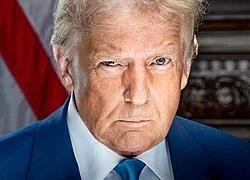
Donald Trump is not governing primarily through the US presidency’s constitutional prerogatives—the powers that would automatically pass to Vice President JD Vance—but through personal intimidation, loyalty networks, theatrical dominance, and the systematic weakening of institutions that would otherwise operate independently of his will. He has attacked the civil service, fired inspectors general, bent law enforcement toward personal and political ends, and treated neutral offices as instruments of private rule. These are not incidental abuses. They are assaults on the impersonal infrastructure that makes constitutional continuity possible.
That is why the reassuring answer—Vance would succeed him—is inadequate. Vance would inherit the office. He would not inherit Trump’s personal authority over frightened legislators, donors, media owners, prosecutors, or foreign leaders. He would not inherit the peculiar mixture of fear, dependency, and cultic attachment by which Trump has replaced institutional government with personal rule. This kind of power is not constitutional. It is not transmissible. It cannot be bequeathed by amendment. It dies with its owner.
This is the real continuity-of-government crisis in America. Trump has not merely concentrated power; he has hyper-personalised it. He has degraded the institutional structures that allow the state to function without him, replacing them with forms of command that exist only in relation to him. Succession exists because presidents are mortal, because incapacity is possible, and because unforeseen rupture is certain to come sooner or later. Trump, however, is interested only in a different kind of emergency: the fake or exaggerated crisis that licenses rule-breaking in the present. A migrant caravan becomes an invasion; a legal dispute becomes a coup attempt. Crises that he can manufacture, manipulate, and exploit enlarge his discretion. They convert law into theater and exception into method.
Trump’s own death or incapacitation is the one emergency that does not interest him, because it offers him nothing. It cannot be staged for advantage. It cannot be weaponised against an opponent. It cannot be declared on his terms.
Preparation for that kind of emergency would mean strengthening the civil service rather than gutting it, protecting inspectors general rather than firing them, preserving prosecutorial independence rather than corrupting it, and accepting that the state’s operating logic must remain independent of the ruler’s personality. The contradiction at the centre of Trumpism is that personalistic rule cannot prepare institutionally for its own absence without undermining itself.
Iran, however repressive and however ugly its constitutional order, still grasps a truth that Trump’s America is forgetting: regime resilience depends on the separation of the ruler’s body from the body politic. The irony is stark. While the US wages war on the assumption that killing leaders can destroy states, Trump is busily making that proposition terrifyingly plausible at home. Yes, the US still has an agreed succession formula. But that formula matters only if the institutions surrounding it still function. Whereas the US was built on the assumption that the political body outlives the mortal one of its president, Trump is president only in the present tense. Unlike the Islamic Republic, the American Republic has only one body now. And a political order with only one body does not outlive it.
The writer is Professor of Law at New York University School of Law.