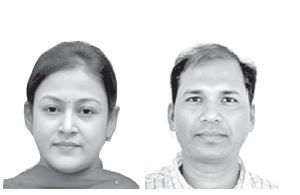
By Antarjeeta Nayak and Ramakrishna Biswal
Every February, the Union Budget acts as a national reflection. Ministries examine it for approval, sectors look to it for support, and citizens search for hope in the details. Departments like railways, agriculture, and education receive specific budget allocations, each backed by sector experts and political supporters. However, amidst these carefully considered goals, nearly 2.7 crore Indians with disabilities remain overlooked, financially invisible, administratively lost, and politically sidelined, as India lacks a dedicated disability budget.

This gap is not just a simple oversight. It highlights a troubling truth: disability does not fit into India’s development discussions. Persons with disabilities (PwDs) are among the country’s most vulnerable and economically marginalized groups. They appear in policy statements but are absent from financial planning.
Globally, development economists recognise disability inclusion as foundational to human capital formation and poverty reduction. India, however, continues to treat disability as a residual welfare concern rather than a development priority. Unlike education, health, or agriculture, disability expenditure in India has no consolidated budget statement. Funds are fragmented across ministries without a unified accounting or outcome framework. The result is predictably grim.
Allocations for implementing the Rights of Persons with Disabilities (RPwD) Act have fallen sharply — from Rs 240.39 crore in 2022–23 to Rs 135.33 crore in 2024–25, a staggering decline of nearly 43% in just two years. Even these reduced allocations remain partially unspent. What is more alarming is not merely the shrinking envelope, but the absence of accountability. There is no comprehensive assessment of whether public spending improves access to education, employment, healthcare, or dignity for PwDs.
Healthcare is both a human right and a critical component of economic security. Yet, over 80% of persons with disabilities in India lack any form of health insurance coverage, whether governmental or private. Over 50% of applicants who attempt to acquire a policy face rejection, often without transparent reasons. These figures point to deep systemic barriers like discriminatory underwriting practices, inaccessible digital platforms, high premiums, and a pervasive lack of outreach focused on PwDs.
Despite legal safeguards in the RPwD Act and directives from the IRDAI, practical exclusion persists. Disability increases household healthcare expenditure by 2–3 times compared to non-disabled households. Ayushman Bharat (PM-JAY) and other broad health insurance programmes aim to provide coverage for low-income families. However, disability often intersects with chronic health needs, rehabilitation services, and long-term care — needs that exceed episodic hospitalization coverages and demand tailored policy design.
It is one thing to cover hospital bills, and it is another to fully account for the higher out-of-pocket expenses, lifelong assistive technology needs, and routine therapy costs that many PwDs incur.
The absence of a dedicated disability budget reflects a deeper structural failure, where India has not integrated disability into the logic of economic planning. Existing health expenditure patterns are skewed towards episodic and curative interventions, with chronic under-funding of community-based rehabilitation, assistive technologies, mental health services, and lifelong support systems. A dedicated budget would allow for a shift from crisis-driven spending to preventive and life-course-oriented investment.
While global best practices increasingly adopt disability-responsive budgeting, India continues to relegate disability to the margins of social justice discourse. Countries like Australia, through its National Disability Insurance Scheme, treat disability spending as long-term social investment. The United Kingdom ensures fiscal transparency through disaggregated disability expenditure, enabling parliamentary scrutiny and evidence-based reform. South Africa embeds disability budgeting within its constitutional mandate for social justice, using fiscal policy as a tool of structural redress. But India does not have any such provisions.
A clearly defined disability budget line—on par with major sectoral budgets, would transform disability from a residual welfare concern into a core development priority. Specifically, such a budget would enable, set measurable and time-bound targets for health coverage, inclusive education, skill development, employment generation, and social protection for persons with disabilities. It would also ensure disaggregated allocation and outcome monitoring, allowing expenditures to be tracked by type of disability, region, gender, and socio-economic status.
Global experience demonstrates that disability budgeting is not an act of charity but a tool of economic governance. Countries that invest systematically in disability inclusion reap dividends in productivity, reduced dependency, and social cohesion. India’s continued failure to institutionalise a dedicated disability budget risks perpetuating a cycle of invisibility, inefficiency, and exclusion.
Ultimately, a disability budget is not just about allocating funds—it is about redefining who counts in economic planning. Until persons with disabilities are visible in fiscal policy, India’s development narrative will remain incomplete. A dedicated disability budget, supported by mandatory inclusive health insurance provisions, would mark a historic shift — from welfare-driven compassion to rights-based economic citizenship, aligning India’s fiscal priorities with its constitutional values and global development commitments.
Antarjeeta Nayak is an independent researcher, columnist and author, while Ramakrishna Biswal is an Associate Professor at NIT Rourkela, Odisha.