SN Misra
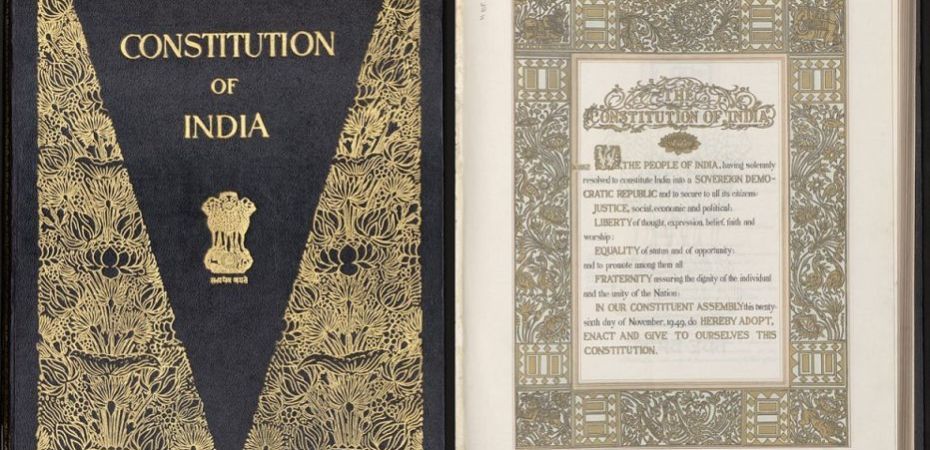
As India celebrates its 71st Constitution Day it would be appropriate to recall what Justice John Marshall, the longest serving Chief Justice of the US, had observed: “A constitution is framed for ages to come and it is designed to approach immortality as nearly as human institutions can approach it. Its course cannot always be tranquil.” Indeed, the course of the Indian Constitution has been far from tranquil and it has witnessed 104 amendments so far. The most transformative amendments have been the addition of the words ‘socialist’ and ‘secular’ to the Preamble (1977), deletion of right to property as a Fundamental Right (1978), addition of right to education as a Fundamental right (2002), three-tier democracy of panchayats and municipalities (1993), formation of GST Council (2016), and anti-defection laws (1985).
Also Read


The Parliament had tried to assert its supremacy by having unfettered powers to amend, delete or emasculate any provision of the Constitution in its 24th amendment. However, the path-breaking Kesavananda Bharati judgement (1973) checkmated the powers of the Parliament, by enunciating the basic structure doctrine, which includes secularism, federalism, separation of power and the power of the Supreme Court to exercise judicial review as inviolable.
Stung by this judgement, the Parliament tried again to amend Article 368 by taking away the power of judicial review and by making the Parliament’s will supreme. The Supreme Court in the Minerva Mills case (1980) gave a body blow to such untrammelled power of the Parliament, by striking down both 368(4) & (5). To quote Justice Chandrachud: “The donee of a limited power cannot by the exercise of that power convert the limited power into an unlimited one.” This judgement finally cemented the position of the Supreme Court as the last arbiter of people’s hopes and aspirations and an unshakable check and balance against Parliamentary absolutism.
Federalism has been identified as one of the basic cornerstones of the Indian Constitution. However, blatant misuse of Article 356 by the Governors as agents of the Centre has deeply dented Centre-State relationship. In the Bommai judgement (1994), the court clearly ruled that majority of a contending party cannot be decided in the lawns of Raj Bhawan but on the floor of the assembly! The Bommai judgement marked a watershed moment in the relationship between the Parliament and the judiciary and reaffirmed the Minerva Mills judgement. In a sense it has ensured that arbitrary dismissal of State Governments is prevented.
Prof. Andre Beteille wrote: “A constitution indicates the direction in which we are to move, but the social structure will decide how far we are able to move and at what pace.” The founding fathers were of the view that reservation of SC/ST will remain a transitional requirement. It has sadly persisted and the politics of caste has now gone beyond OBC to reservation for the upper caste on basis of economic criteria. Politics of caste has trumped merit and dented the right to equal opportunity.
The Supreme Court emerged as a strong institution after the Kesavananda Bharati judgement. However, denial of speedy access to justice through dilatory and self-indulgent process has been rampant in which judges and lawyers are equally guilty. There is also a perception, going by recent the approach of the Supreme Court that it has taken a predominantly pro government approach. It has also delayed dispensing its judgement on matters of national importance like scrapping of Article 370 or dealing with the purchase of Rafale aircraft. There is also clear dichotomy in its treatment of freedom of speech cases.
After 50 years of working of the Constitution, the Atal Behari Vajpayee government had appointed a constitutional review panel in 2002 to suggest measures to improve it. Some of the important changes it had suggested are (a) to include freedom of press as a fundamental right, (b) right to compensation, if life or liberty is illegally deprived and right to privacy. It had also suggested that the Governor’s report for invoking Article 356(1) (constitutional emergency) should be a speaking document containing a precise and clear statement of all material facts and grounds, on the basis of which the President may satisfy itself, as to the existence or otherwise of the breakdown in constitutional machinery. It had also suggested for the establishment of a National Judicial Commission to appoint judges to the Supreme Court. The Commission had also suggested inclusion of a new sub clause 30D as per which right to safe drinking water and pollution-free environment should be a fundamental right.
These recommendations should have been put in place, going by the experience of ‘horse trading’ that takes place for assuming political power in the States, and also to cleanse the impression that the existing collegiums system is opaque for selecting judges to the High Court and the Supreme Court. It is indeed a pity that the Supreme Court did not uphold the concept of a National Judicial Appointment Committee, which was struck down under the alibi of offending ‘basic structure doctrine’. This is rather unfortunate as both merit and transparent selection process will lend gravitas to the judiciary and carry faith of all Indians. There are rumblings that the present government, given its brute majority, is contemplating a further review of the constitution to delete secularism. This would be highly ill-advised as secularism is a basic structure of our democratic polity as clarified in both Kesavananda and Bommai judgements.
There are many subtexts of socio-economic justice that need to be given urgent attention. One of them is the mismatch between free and compulsory education (6-14 years) as a Fundamental Right (Article 21A) and early childhood education as a directive policy (Article 45). The New Educational Policy has struck a right note by recommending that the early childhood education (3-6 years) and provision of adequate nutrition to these children should be made a Fundamental Right. Given India’s poor human development record, quality deficit in education and large-scale malnutrition amongst children as brought out by the Global Hunger Index it is high time the scope of Article 21A is expanded to include early childhood care and education as Fundamental Right. If India is to reap demographic dividend, the Constitution must ink suitable provision for ensuring right to quality education, adequate nutrition and healthcare to every child irrespective of caste, class and religion.
The writer teaches Constitutional Law.