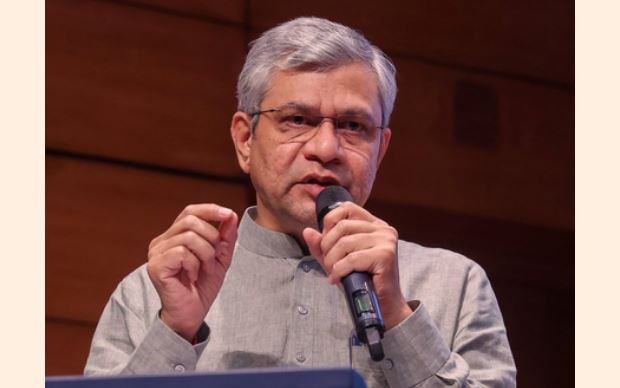
New Delhi: Amid concerns from news publishers that a new law could constrain investigative reporting, Information Technology Minister Ashwini Vaishnaw on Wednesday said the Digital Personal Data Protection (DPDP) Act does not infringe press freedom, asserting that the Constitution guarantees journalistic independence.
“The journalistic freedom is guaranteed by the Constitution of India. That freedom is absolutely available. There is not even an intention to affect the journalistic freedom,” Vaishnaw said.


“The privacy law absolutely maintains, fully maintains the journalistic freedom, the Constitution guarantees,” he said, maintaining that the legislation was intended to protect personal data without impinging on media freedom.
Meanwhile, sources indicated that the government would be open to amending the law to explicitly safeguard journalistic activity.
Vaishnaw said the DPDP Act followed a Supreme Court judgment that recognised the right to privacy as a fundamental right.
The law was framed after more than a year of consultations involving newspapers, television channels, media representatives, the information technology industry and other stakeholders, he pointed out.
“It was clearly explained that provisions of the DPDP Act nowhere infringe upon freedom of the press, journalism and freedom of media,” the minister said.
He also invited editors and media professionals to engage in an open dialogue with the government to discuss concerns surrounding the legislation.
The remarks came amid a legal challenge by news publishers over the law’s potential impact on journalism. Publishers have argued that the absence of an explicit exemption for journalistic activities could make it harder to report on matters of public interest, particularly investigations involving personal information collected without the subject’s consent.
Also Read : Bhubaneswar hosts three-day national convention of CS
Their concerns centre on requirements governing notice, consent and the processing of personal data, as well as the potential implications for retaining information relevant to investigations and protecting confidential sources.
While the DPDP framework seeks to regulate the processing of digital personal data, media organisations say applying its requirements to journalistic work without specific safeguards could hamper investigations into alleged wrongdoing.
News publishers argue that the law does not provide an explicit exemption for journalistic activities and could constrain reporting that involves the collection and use of personal information.
The dispute centres on how the law’s requirements governing the processing of digital personal data would apply to news organisations, particularly when journalists investigate matters of public interest without the consent of the individuals concerned.
Publishers have warned that requirements relating to notice, consent and data erasure could complicate investigative reporting, while raising concerns about the protection of confidential sources and the ability to retain information relevant to public-interest journalism.
The government’s position, as articulated by Vaishnaw, is that the legislation protects personal privacy without curtailing constitutional guarantees of press freedom.
A top source, meanwhile, indicated a possible legislative route for addressing concerns over the absence of an explicit journalistic exemption. In response to a question about whether such protection could be expressly written into the law, he said an amendment would be possible if required.
“If hardcoding is required, we can hardcode it; it only requires an amendment,” the source said.
“There is no problem in that because our intent is clear.”
The source said the intent of the government is clear, but it is willing to sit and discuss.
“This is not a big problem which cannot be solved. And if, because of this, there is any confusion, how much time does it take to clear that confusion…Go to parliament, and make an amendment.”
PTI