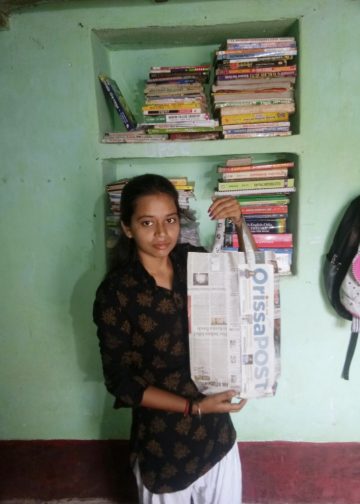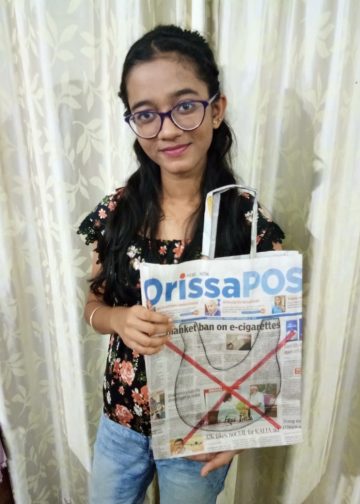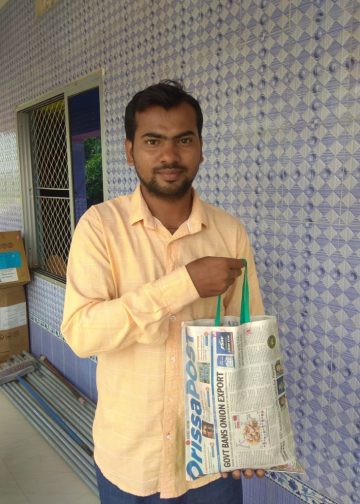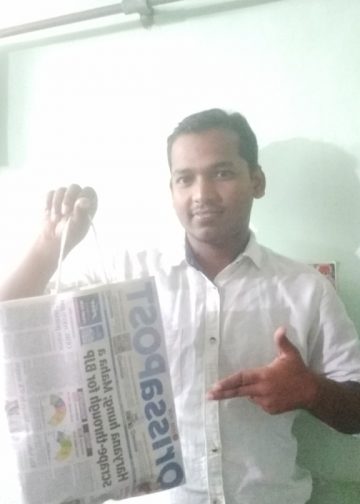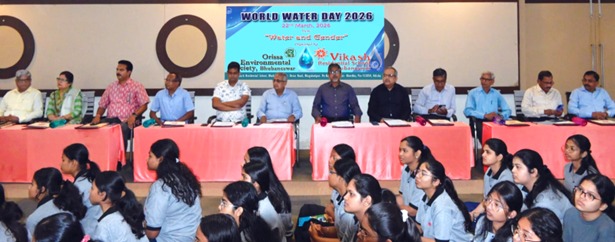
Bhubaneswar: Water and gender are closely interconnected, particularly in developing and underdeveloped regions, where women and girls often bear the primary responsibility for collecting water for household use, experts viewed during the observance of World Water Day, jointly organised by Orissa Environmental Society (OES) and Vikash Residential School, Kantabada here on the theme ‘Water and Gender’.
The task frequently involves travelling long distances, consuming significant time and energy, which can lead to girls missing school and women having fewer opportunities for paid work or community participation, as expressed by the participants.


Limited access to safe water also affects health and hygiene, disproportionately impacting women.
Inadequate water supply makes menstrual hygiene management difficult, leading to discomfort, stigma and reduced mobility.
Also Read: Odisha CM unveils 141 water-related projects worth Rs 2,612 cr
Unsafe water sources further increase the risk of waterborne diseases, with women often managing these challenges as caregivers within families.
Gender inequality is also reinforced when women, despite being the primary users and managers of household water, have little say in water management decisions and infrastructure planning, they said.
The programme, held under the chairmanship of school principal Vijay Kumar, featured OES working president Jayakrushna Panigrahi as the chief guest.
Speaking at the event, Panigrahi stressed that addressing water and gender issues requires inclusive approaches that ensure equal participation of women in decision-making, improved access to nearby clean water sources, and education on hygiene and sanitation.
He also highlighted the UN-Water campaign message, ‘Where water flows, equality grows’.
School chairman V Srinivas urged students to act as vigilant stewards of nature to conserve water and protect the environment.
Outfit secretary Manoranjan Mishra delivered the introductory address, outlining the significance of the theme, while joint secretary Surabhi Jain presented on rainwater harvesting and the basic calculations involved.
Among others, Bijay Ketan Patnaik, Lala A K Singh, Sandeep N Kundu, Padmaja Suryaprabha Sahu and Soumyaranjan Nayak also shared their opinions, emphasising that empowering women in water governance promotes gender equality and leads to more sustainable and effective water management systems.
Ramesh Chandra Panda and Parshuram Panda conducted a quiz on water-related issues for students, and the winners were awarded prizes.
Programme coordinator V Rabindra Nath proposed the vote of thanks. More than 400 students and OES members attended the event.