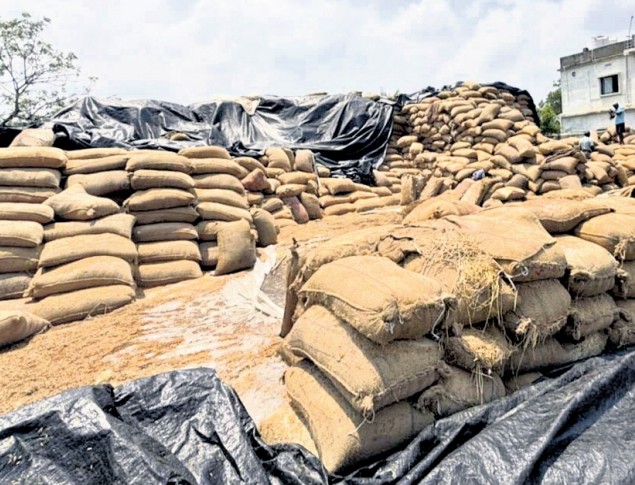
Tihidi: More than 70,000 quintals of paddy lie heaped in the open outside mandis across Tihidi block in Bhadrak district, with continuous rain soaking the stocks and even leading to sprouting, as delayed lifting by millers leaves farmers without payments and authorities struggling to prevent further damage.
The situation has arisen as millers have failed to lift procured paddy on a regular basis, leading to a massive backlog across multiple procurement centres. With no adequate storage facilities in place, mandi authorities have been forced to keep the paddy bags in the open, exposing them to inclement weather.


Over the past few days, persistent Nor’wester rainfall has worsened the situation, with large quantities of paddy getting drenched and beginning to germinate. Officials at various mandis said they are under severe strain trying to safeguard the stocks, even as losses mount. The procurement deadline for the current kharif season was initially fixed for March 31.
However, after reports emerged that many farmers were unable to sell their produce within the stipulated period, the deadline was extended by seven days, allowing wider participation. Despite this extension, hundreds of farmers who have already sold their paddy are yet to receive their dues, sparking widespread resentment.
Many are now struggling to manage daily expenses and repay loans, as payments remain pending. At Bamanbindha mandi, around 14,000 quintals of paddy are lying in the open. The centre is also linked to the Bahabalpur panchayat, adding to the procurement load. Similar conditions prevail at several other mandis across the block.
Shyamsundarpur mandi has about 6,000 quintals of paddy yet to be lifted, with nearly 2,000 bags already damaged by rain. Other centres facing significant backlogs include Mangalpur (7,000 quintals), Andarai (5,000 quintals), Jamajodi (8,000 quintals), Gandhinagar (8,500 quintals), Charitaraf (3,800 quintals), Amritpur (5,500 quintals), Laxminarayan SHG at Sindol (8,000 quintals), Maa Saraswati SHG at Harsinghpur (5,000 quintals), and Paliabindha and Nischintapur mandis (2,200 quintals each).
In the absence of proper storage infrastructure, authorities had covered the paddy stacks with tarpaulin sheets. However, continuous rain has rendered these measures inadequate, leading to water seepage and damage. In several instances, sprouting has been reported, forcing mandi authorities to engage labourers to dry the paddy in the sun whenever the weather permits.
Mandi officials said they are struggling to manage the crisis and have urged immediate intervention to prevent further losses. Representatives of cooperative societies and self-help groups have also demanded that millers lift the paddy without delay.
Block Supply Inspector Pritish Samal said higher authorities have been informed of the situation and steps will be taken to ensure early lifting of paddy by millers.
The unfolding crisis highlights persistent gaps in procurement logistics, leaving farmers vulnerable to both natural vagaries and systemic delays.