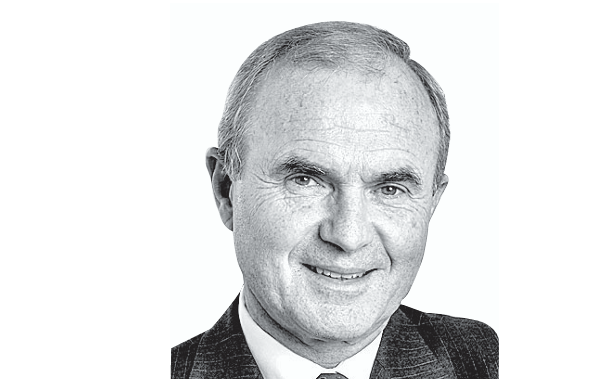
By Otmar Issing
Following the 2007–08 global financial crisis, the world’s leading central banks spent more than a decade unconcerned about inflation. Instead, they focused their efforts on combating deflationary pressures, while academic discourse was dominated by the notion of secular stagnation and its implications for monetary policy.


From 2021 onward, however, the picture changed abruptly, and double-digit inflation rates soon became commonplace. Central banks were caught by surprise and blamed unforeseen factors, primarily the COVID-19 crisis.
This explanation suggested that there was no reason to tighten monetary policy. Indeed, some policymakers even feared that, within a year or two, central banks would once again face the “danger” of excessively low inflation.
As would soon become apparent, this was a serious misdiagnosis. It stemmed from a failure of traditional inflation forecasting methods, mostly based on neo-Keynesian models. A series of demographic, environmental, and geopolitical shocks, above all COVID-19, should have made central banks wary of relying on these models. After all, the late Nobel laureate Robert Lucas’ critique is standard in macroeconomics: significant disruptions can alter the relationships between key economic variables, causing models to lose their predictive power.
Viewed through that lens, it should have been obvious that the downturn triggered by the pandemic was not a cyclical recession, even if forecasting models treated it as one. Despite the difficulties in explaining price developments through supply and demand, other indicators clearly signalled inflationary pressures.
Only central banks that had long ignored monetary developments could have overlooked the rapid growth of the money supply, fuelled by massive public debt issuance and large-scale central-bank bond purchases. The instability of money demand had led most economists to regard the monetarist prescription of targeting the money supply as obsolete.
But does this imply that double-digit money supply growth—with M2, a broad measure of the money supply, in the US surging by 25% in 202l—deserved no attention whatsoever? Is it all that surprising that, contrary to central-bank forecasts, inflation also rose sharply? Astonishingly, major central banks neither publicly acknowledged this oversight nor seriously reevaluated their monetary-policy strategies, which had failed so spectacularly.
The sole exception was Kevin Warsh, the new chair of the US Federal Reserve, who recently criticised the Fed’s neglect of the money supply and established five independent task forces to reassess Fed policies, one of which will focus on the existing inflation framework.
Inflation targeting leaves no room for the role of monetary developments and also lacks a model that integrates risks emanating from the banking system and financial markets, with all their dynamics, non-linearities, and complexities.
This strategy is bound to fail when such risks become overwhelming. A robust monetary-policy strategy that is resilient to economic uncertainty must be based on an analytical framework that integrates all relevant factors into a consistent overall picture.
The European Central Bank’s “two-pillar strategy” is based on the fundamental understanding that no single, comprehensive model can capture the economy in all its complexity. That remains true today. The two-pillar approach combines an analysis of developments in the real economy, including inflation forecasts, with an analysis of monetary and financial trends, including changes in the money supply.
The two are then “cross-checked” to produce a calibrated overall assessment of economic conditions. While the two-pillar approach is certainly open to criticism and improvement, its major advantage is that individual factors are never reviewed in iso lation.
Instead, they are always assessed within the context of economic and monetary developments. Continuous review is therefore an integral part of this strategy. It is difficult to understand why the ECB, in its 2021 monetary-policy review, abandoned the two-pillar strategy. By design, inflation targeting offers no consistent way to integrate factors outside the inflation forecast into monetary policymakers’ decision-making process.
This weakness undermines the quality of the analy sis and can lead to costly errors when, as with rapid money-supply growth, these factors drive inflation trends. It is time, then, for central banks to undertake a comprehensive reassessment of their monetary-policy strategies.
The writer is former chief economist of the European Central Bank.