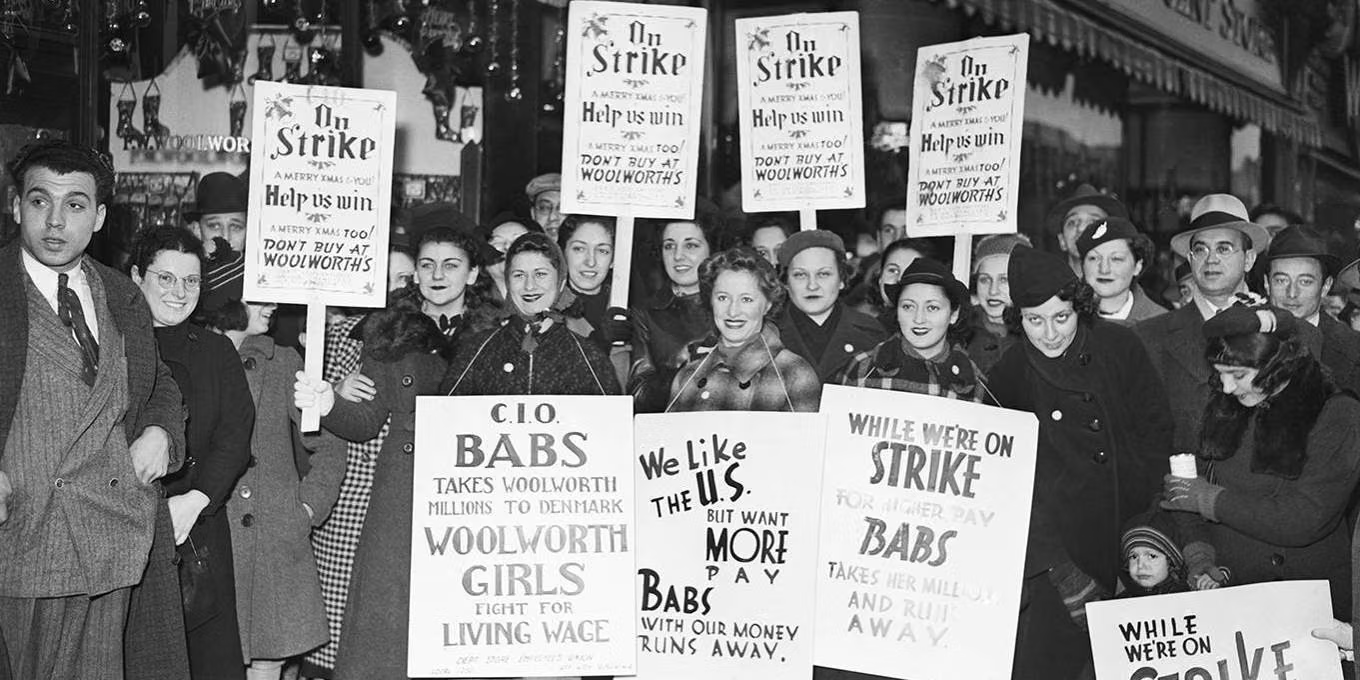
The International Labour Organisation (ILO) was established at a time when, much like today, society was riven by vast inequalities. In the years before World War I, workers’ militant organising and mass strikes alarmed employers and governments. The premise of the ILO Constitution, adopted in 1919, was that collective bargaining could prevent revolution by turning class conflict into negotiated, shared gains.
This arrangement assumed that an international floor for labour standards would halt a race to the bottom on wages and working conditions as countries compete for trade and investment. For roughly three decades after World War II, that assumption generally held up, benefiting millions of workers, though mostly in formal employment in the industrialised Global North.


It is no longer the case today. The UN’s 2026 Sustainable Development Goals Annual Report notes that the weakening of labour rights worldwide is “leaving many increasingly constrained or unable to organise or bargain collectively.” According to the International Trade Union Confederation’s Global Rights Index, 80% of the 121 countries surveyed restricted collective bargaining in 2026, and 87% restricted the right to strike. The OECD also reports that union density has been falling in its member economies for decades. In many countries, capital is more concentrated, and governments are more captured by it, than at any time in the last century.
The unravelling of the 1919 compromise was not an accident. The relationship between firm and worker, and the corresponding obligations, were intentionally severed through vertical disintegration across global supply chains, subcontracting, and labour intermediation. Digital-platform work, the most recent manifestation of this, relies on widespread employment misclassification that denies millions of workers their legal rights.
Although global value chains have been a reality of manufacturing and services for decades, not enough progress has been made on negotiating global rules to protect workers’ rights and hold lead firms accountable. Employers’ opposition to standard-setting on this issue at the ILO remains deeply entrenched. They insist that, instead of regulating their practices, we should focus on getting results from labour inspectorates—government agencies that are usually underfunded and disempowered—at the site of manufacture or service provision.
Many countries no longer have the capacity or the incentive to legislate a global rights floor, owing to economic liberalisation and capital mobility. At the same time, investors have acquired and used provisions of trade and investment agreements to sue governments directly over laws and policies that might affect their profitability. Moreover, governments put other priorities ahead of enforcing laws that would help raise living standards. Even the novel “rapid response labour mechanism” under the United States-Mexico-Canada Agreement, designed to promote freedom of association and collective bargaining at the firm level, is faltering for lack of political will.
Addressing these problems will require more than another declaration. Organised workers and the fear of revolution produced the bargain of 1919. The ILO Constitution merely ratified what worker power had already achieved. Its premise remains valid—and a robust global labour architecture is still necessary—but the assumption that compromise was somehow self-executing was always mistaken. Instead, workers’ organisations have been steadily undermined by regressive legislation and a multi-billion-dollar industry that supports employers’ “union avoidance” efforts.
Fulfilling the ILO’s promise requires a concerted global effort to create an enabling environment for all workers and their organisations to organise and bargain collectively, at home, across borders, and down supply chains, where decision-makers are located. Countervailing power must be rebuilt, including by ensuring that labour can operate across borders as easily as capital does. That means institutionalising transnational collective bargaining, as well as sectoral bargaining and extension mechanisms (which spread union contracts to other workers). Solidarity action needs to be protected, or else the right to strike can do little good when decision-makers are located elsewhere. And vulnerable workers—including the two billion informal workers, digital-platform workers, and dependent self-employed workers—require an effective right to organise and bargain.
Labour rights must be an effective feature of international economic governance as well. While the ILO supervisory system may have persuasive remedies, they need legal regimes to give them effect. Compliance will never be mandated in Geneva. It must be enforced through constitutional litigation, regional human-rights courts, trade agreements, and procurement and financial regulations. That could mean rapid, trade-linked remedies against companies that violate workers’ fundamental rights, and enforceable supply-chain agreements between workers, brands, and suppliers.
With the world poised to overshoot the Paris climate agreement’s target of limiting global warming to 1.5° Celsius, these reforms have become essential. The climate crisis is also a crisis of workers’ rights, and addressing one can address the other. Global warming is already affecting workers, whether through job displacement in carbon-intensive industries or through extreme heat, crop failure, coastal erosion, and other disasters. While workers and trade unions are widely recognised as indispensable actors in any just climate transition, the legal infrastructure needed to ensure that they have a voice in shaping that transition is underdeveloped or non-existent in many countries.
Finally, the expansion of AI, automated management, and digital surveillance is rapidly transforming work, threatening jobs and fundamental rights, and further exacerbating inequality, from warehouses to digital labour platforms.
Where workers’ organisations once could bargain effectively, now authoritarian oligarchs largely control the levers of power. That need not be the case. We can reverse this lopsided dynamic, but only if workers can lawfully organise and act on the same scale as capital. Addressing the challenges of our time depends on it.
Jeffrey Vogt is Chair of the International Lawyers Assisting Workers Network. Monika Mehta is Deputy Director of the International Lawyers Assisting Workers Network. ©Project Syndicate