


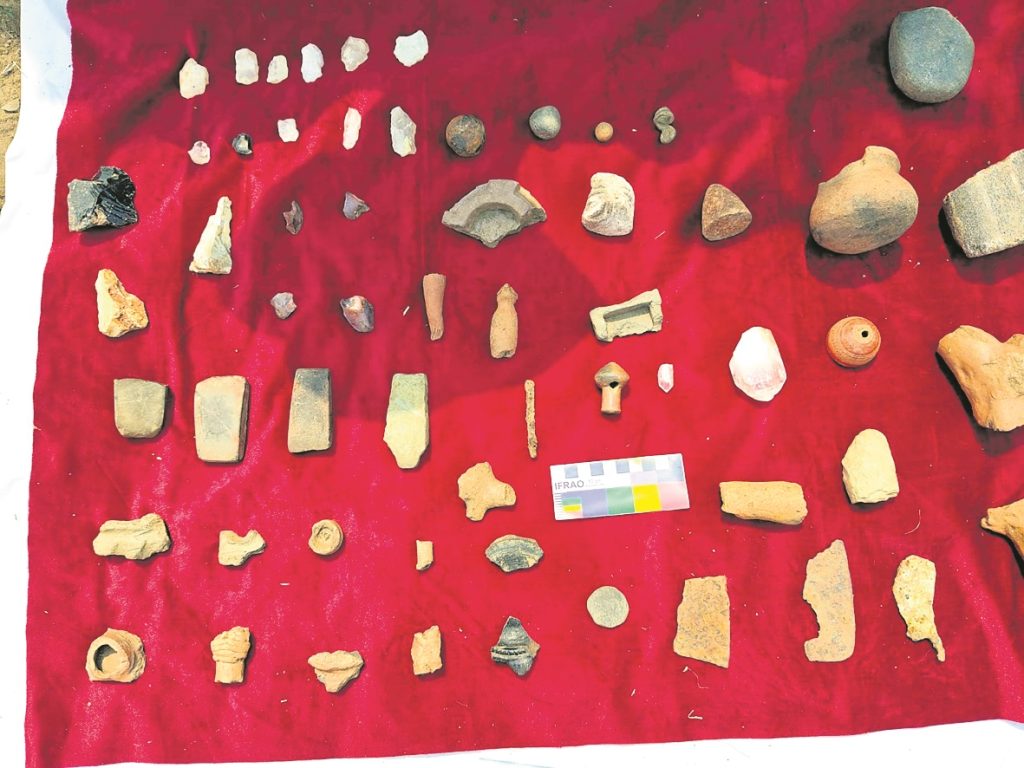
Rairakhol: Archaeologists have discovered evidence of an ancient urban settlement and a flourishing iron-smelting industry at Purunagarh in Sambalpur district, shedding new light on the region’s early history and cultural development. The discoveries were made during an excavation conducted by the Department of History at Gangadhar Meher University (GMU) with permission from the Archaeological Survey of India (ASI).
Located on the banks of the Kerandi River, a tributary of the Mahanadi, the site has revealed traces of continuous human habitation from prehistoric times to the early medieval period. Excavations reaching a depth of about 90 cm have yielded a range of artefacts, including prehistoric stone tools, Chalcolithic axes, pottery, beads, grinding stones, sharpening stones and other household objects.
According to excavation director Atul Kumar Pradhan, the project aims to establish the cultural sequence of the Rairakhol region and examine ancient metallurgical practices, particularly traditional iron-smelting technology.
Among the most significant findings is the discovery of thousands of iron slag fragments spread across the excavation area. Archaeologists believe these remains indicate the existence of a well-developed iron production and processing industry that once operated at the site. The excavation has also uncovered furnaces, storage pits and large quantities of pottery, suggesting organised habitation and specialised crafting activity. Vice-Chancellor Byomakesh Tripathy said the findings indicate that Purunagarh was not merely a settlement but may have functioned as an ancient urban centre. Researchers believe the discoveries could substantially enhance understanding of western Odisha’s role in the region’s cultural and technological evolution.
Orissa POST – Odisha’s No.1 English Daily