

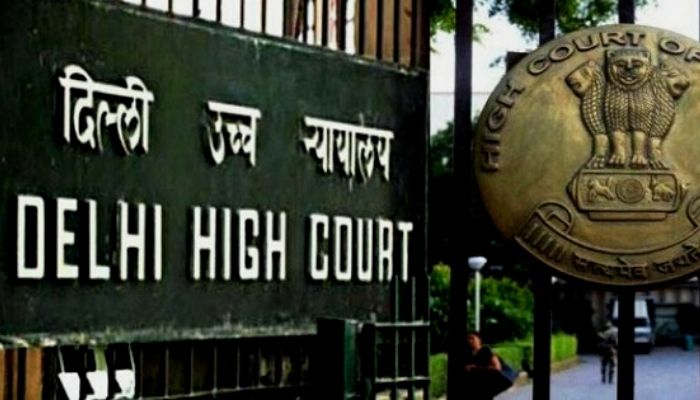
New Delhi: The Delhi High Court has dismissed a plea filed by candidates belonging to the Economically Weaker Sections (EWS) seeking age relaxation and additional attempts in the Civil Services Examination on a par with the Scheduled Castes (SC), Scheduled Tribes (ST) and Other Backward Classes (OBC).
A Division Bench of Justices Anil Kshetrapal and Amit Mahajan held that the policy decision of the Centre not to extend such relaxations to EWS candidates does not suffer from arbitrariness or unconstitutionality and falls outside the scope of judicial review.
The petitioners had challenged the Department of Personnel and Training (DoPT) Office Memorandum dated January 31, 2019, the 2022 FAQs, and the Civil Services Examination (CSE) 2024 notification issued by the Union Public Service Commission (UPSC), contending that denial of age and attempt relaxations to EWS candidates violated Articles 14 and 16 of the Constitution.
They sought directions to grant EWS candidates the same concessions as available to SC/ST/OBC candidates in direct recruitment to posts under the Union government.
Rejecting the plea, the Delhi High Court held that matters relating to the grant of relaxations in age and number of attempts are part of policy formulation, which lies within the domain of the executive and legislature.
“At the outset, it is imperative to appreciate that while exercising jurisdiction under Article 226 of the Constitution, Courts do not enact laws or frame policies and the same is in the domain of the Legislature and Executive,” the Justice Kshetrapal-led Bench observed.
It further held that judicial review in such cases is limited to examining whether a policy violates fundamental rights or is manifestly arbitrary, and not its wisdom or fairness. “The Executive is entrusted with the task of formulation and implementation of policies…To subject such policy decisions to judicial substitution merely because a different view appears more prudent or equitable would violate the doctrine of separation of powers,” observed the Delhi High Court.
On the claim of parity, the Justice Kshetrapal-led Bench said that the EWS category, introduced through the 103rd Constitutional Amendment in 2019, stands on a distinct footing compared to SC/ST/OBC categories. “The hardship faced by individuals in this category arises from lack of financial resources. It does not stem from social stigma or historical exclusion,” it said.
In contrast, the Delhi High Court observed that SC, ST and OBC categories are rooted in “deep and long-standing social and educational backwardness” arising from caste-based discrimination.
The judgment emphasised that economic disadvantage is inherently fluid and can change over time, unlike caste, which is determined by birth and carries lasting social consequences. “Since the handicaps faced by socially backward classes and economically deprived classes are not the same, different ancillary concessions and relaxations can be provided to both categories,” the Justice Kshetrapal-led Bench held.
It added that EWS candidates cannot claim automatic parity with SC/ST/OBC candidates in matters such as age relaxation or number of attempts. The Delhi High Court also rejected the argument that some states and Union Territories, including Jammu and Kashmir, have granted such relaxations to EWS candidates.
“No claim of parity can be sustained between policies framed by the Union and those adopted by individual States or Union Territories,” the Justice Kshetrapal-led Bench said, adding that service conditions fall within the exclusive domain of the respective recruiting authorities.
It further noted that similar pleas had earlier been rejected by the Delhi High Court and the Madhya Pradesh High Court.
Holding that the petitioners failed to demonstrate any violation of constitutional or statutory provisions, the Delhi HC declined to interfere with the existing policy framework.
“In such circumstances, the assailed policy decision falls squarely outside the permissible scope of judicial review and warrants no interference,” the Justice Kshetrapal-led Bench said, dismissing the petition.