
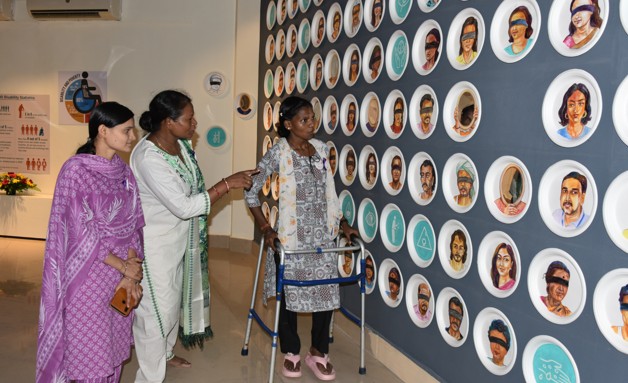
Bhubaneswar: Disability data is not merely about statistics—it is about human rights, dignity, and equal opportunity.
Every person deserves to be counted, recognised, and included, said Swabhiman Founder Sruti Mohapatra at the ongoing four-day public exhibition in the Lalit Kala Akademi, which creatively combines contemporary art, census data, and public dialogue to initiate talks on disability in population, development, and governance. “Development begins with visibility.
When people are not counted, they are not considered in planning, budgeting, or policymaking,” she added. In order to address these critical issues, Swabhiman launched a first-of-its-kind initiative to bring disability inclusion into the national conversation through art.
Persons with disabilities often remain undercounted, underrepresented, and overlooked in official data.
Their absence from statistics frequently trans lates into exclusion from public policies, development planning, budgeting, and governance.
According to the World Health Organisation (WHO), nearly 16 per cent of the global population—over 1.3 billion people—live with disabilities.
However, India’s 2011 Census recorded only 26.8 million persons with disabilities, a figure widely regarded as a significant underestimation with far-reaching implications for policy formulation, resource allocation, and inclusive governance.
Addressing the gathering, acclaimed sand artiste Sudarshan Pattnaik said, “Art is not meant only for beauty.
It has the power to educate, inspire, and create awareness about important social issues.”
Delivering the keynote address, noted environmentalist and development thinker Jagadananda highlighted the changing demographic realities confronting Odisha and India, stressing the need for inclusive planning based on accurate and representative data.
Curator Bijayanta Das described the exhibition as a landmark initiative that confronts the invisibility of persons with disabilities in India’s census and civic planning.