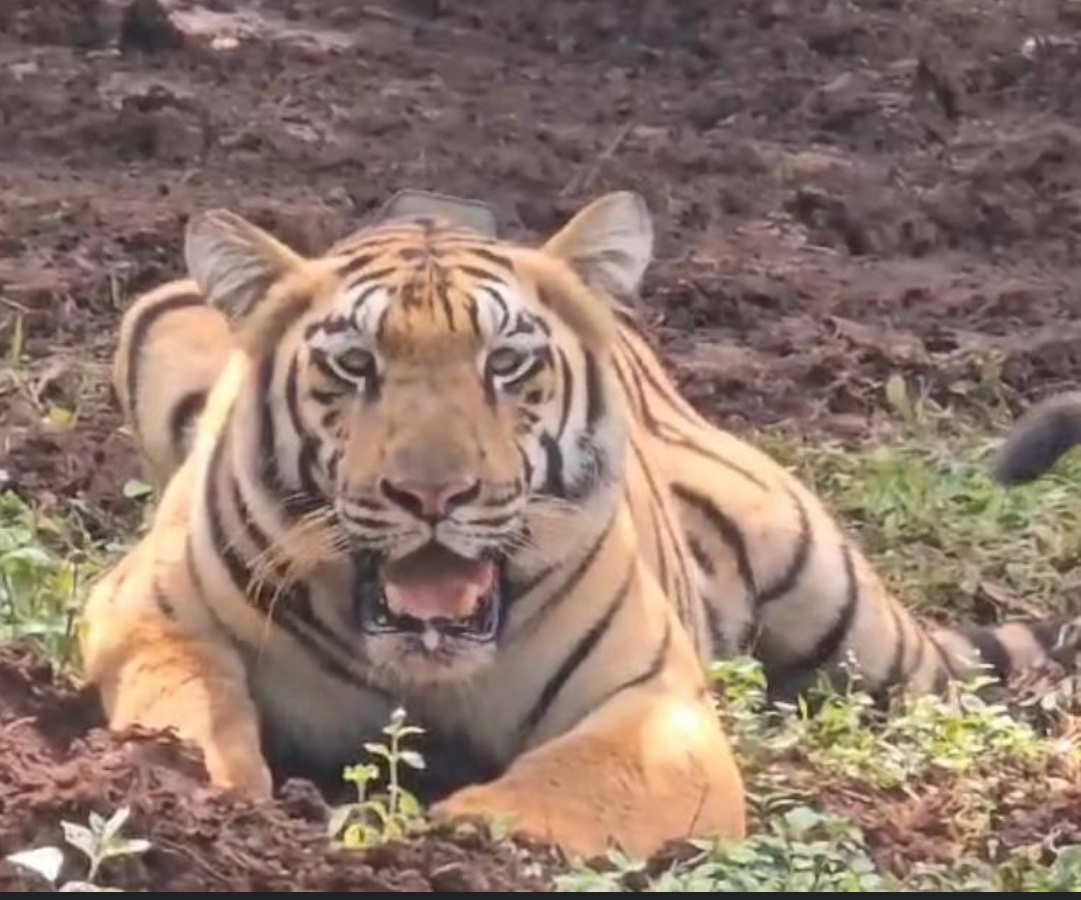
Baripada: A year after tigress Jamuna was relocated from the Tadoba forest in Maharashtra to the Similipal National Park in Mayurbhanj district, doubts have grown over the success of the Forest Department’s objectives behind the move.
According to officials, Jamuna failed to adapt to the forested terrain of Similipal and reportedly strayed into another jungle soon after being released.


Even after a year, she has not returned. However, authorities said the tigress remains somewhere within the broader Similipal biosphere region and her movements are being closely monitored.
Also Read: Rampant quarrying in Similipal foothills rings ecocide alarm
Prakash Chand Gogineni, regional chief wildlife warden and field director of the Similipal Tiger Reserve, said Jamuna’s location is being tracked, but the department has not shared specific details about her whereabouts.
This lack of clarity has fuelled concerns about the effectiveness of the tiger gene pool augmentation plan aimed at boosting the tiger population in Similipal’s ecosystem.
Jamuna was the first of two tigresses brought to Similipal as part of the relocation effort.
However, she soon left the core area of the reserve, wandering into nearby villages and preying on domestic animals.
Unable to adapt to Similipal’s terrain, Jamuna moved through human settlements and escaped to Kuldiha Wildlife Sanctuary in neighbouring Balasore district.
After staying there briefly, she began frequenting Hadagarh Wildlife Sanctuary in Keonjhar district, apparently in search of a suitable habitat.
The department noted that since Hadagarh Wildlife Sanctuary falls within the Baripada forest circle, one of the seven divisions under its jurisdiction, it still lies within Similipal’s broader ecological landscape. Officials said Jamuna’s movements are being closely monitored through her radio collar.
The Forest Department said it will soon launch a new mission to track and study Jamuna’s movements. Former honorary wildlife warden Bhanumitra Acharya, however, expressed doubts about the project’s success.
“The purpose for which the two tigresses were relocated to Similipal seems to have failed,” he said.
“While officials claim Jamuna remains within Similipal’s ecological zone, questions arise about where she will be counted during the national tiger census, under tiger-free Kuldiha or Hadagarh, or as part of Similipal’s population?”
Acharya added that instead of addressing management lapses, the department’s decision to bring tigers from outside and release them into Similipal amounts to “a misleading conservation policy.”
The initiative marked the first time Odisha had attempted to introduce tigers from another state to promote breeding.
With the previous tiger relocation effort in Angul’s Satkosia failing, experts and conservationists are now watching closely to see whether the current plan will succeed or face a similar fate.
Officials say if the project achieves its goals, it could significantly contribute to tiger population growth in the state.
The National Tiger Conservation Authority (NTCA) had identified Similipal Wildlife Sanctuary as one of the most suitable habitats in the country for increasing the tiger population, according to its report.
Following the recommendation, two tigresses, Jamuna and Zeenat, from the Tadoba forest in Maharashtra, were relocated to Similipal as part of Odisha’s plan to boost tiger breeding.
Jamuna arrived at the Similipal Tiger Reserve October 27, 2024, transported by a special team and vehicle.