Nandapur: The state government has reduced the fund allocation for the Shri Anna Abhiyan for 2026-27 by 31 per cent, triggering concern among farmers, entrepreneurs and intellectuals in Koraput district, prompting a complaint before the NHRC.
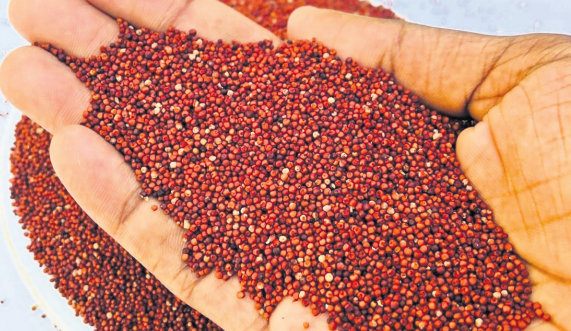
The initiative was launched to revive traditional millets such as ragi, kangu, suan, and bajra, aiming to enhance farmers’ incomes and improve nutrition on people’s plates.


The government has earmarked Rs 400 crore for the mission in 2026-27, significantly lower than the previous allocation.
Farmers’ groups alleged that the budget reduction could adversely affect millet cultivation across the district’s 12 blocks and impact nearly 40,000 hectares of agricultural land, including 17,000 hectares under ragi cultivation.
Under the Shri Anna Abhiyan in 2024-25, around 15,319 farmers reportedly benefited and produced 2,39,875 quintals of ragi.
Farmers cultivating suan, kangu and bajra on nearly 17,000 hectares also became self-reliant by producing about 1,000 metric tonnes of millets.
Entrepreneurs associated with millet processing and marketing have also expressed dissatisfaction over the reduced funding.
In the district, 89 RR cellar polishing units, 20 de-husking machines, 325 grinding units, 106 crushing machines, nine cleaning and grading units, two Mission Shakti cafes, 13 millet snack outlets, 45 customer procurement centres and 45 millet seed sales centres have been established under the programme.
Farmer representatives and intellectuals alleged that a reduction in financial support could affect the livelihoods of 32,123 farmers and more than 70 entrepreneurs linked to the millet sector.
Expressing concern over the curtailed allocation, advocate and human rights activist Anup Kumar Patra has drawn the attention of the Chief Minister, state Agriculture Minister, Chief Secretary and the National Human Rights Commission (NHRC).
The commission has registered the advocate’s complaint for consideration under Diary No. 10681/IN/2026.
The previous state government had launched the Odisha Millet Mission with the objectives of protecting traditional crops like ragi, increasing farmers’ income, conserving the soil quality of upland agricultural fields in Koraput district, and highlighting the nutritional value of millets at the global level to help combat malnutrition.
Following the mission’s success, the Government of India, NITI Aayog, Indian Council of Agricultural Research (ICAR) and Indian Institute of Millets Research (IIMR) conferred the Poshak Anaaj Award on the initiative. The University of Cambridge had also decided to undertake further research, describing the mission as a “green revolution.” The initiative was praised internationally by the International Fund for Agricultural Development (IFAD) and the Food and Agriculture Organisation (FAO).
Farmers were receiving incentives along with fair prices for their produce.
However, the present regime’s decision to rename the Odisha Millet Mission as the Shri Anna Abhiyan and the subsequent reduction in budget have triggered concern among farmers.
Millet growers of Nandapur block and other parts of Koraput district fear the move will adversely affect cultivation and farmland.
They also apprehend that the procurement of millet will decline, leading to a fall in prices. Advocate Patra said the matter has been brought to the attention of the state government and the NHRC.
When contacted, Koraput District Special Development Council Chairman Bhagaban Muduli said Koraput is a predominantly tribal district where people depend largely on agriculture for their livelihood and millet cultivation under the Shri Anna Abhiyan has given Koraput a distinct identity.
Muduli said he would draw the attention of the Chief Minister and the state Agriculture Minister to seek enhancement of assistance under the scheme.
Expressing concern, Pottangi MLA and Congress Legislative Party (CLP) leader Rama Chandra Kadam said the move would adversely affect traditional millet farmers across all 30 districts of the state.
Kadam said he would discuss the matter with the Governor, Chief Minister and Agriculture Minister and raise the issue in the upcoming Assembly session.