
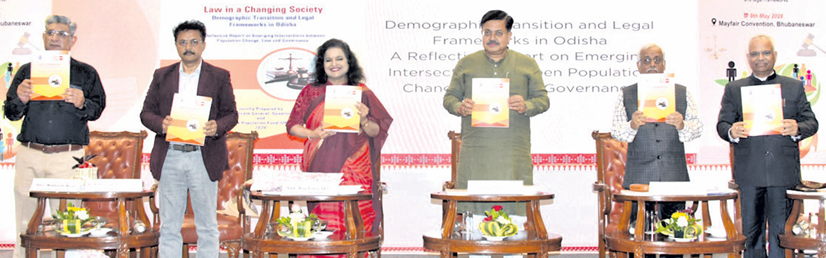
Bhubaneswar: The state government is considering setting up seven women fast-track courts and five special cyber courts to ensure speedy disposal of cases, Law Minister Prithiviraj Harichandan said Saturday.
Participating in a workshop titled ‘Demographic Change and Legal System: Preparing for the Emerging Human Futures’, organised jointly by the Law department and the United Nations Population Fund (UNFPA) here, Harichandan said that, along with population growth, several changes are taking place globally in the social and economic systems.
“Currently, youth account for more than 50 per cent of the total population of the state and the country. However, this figure will change in the coming days. The number of elderly people is expected to increase. Therefore, we will have to prepare a plan keeping in mind the next 50 years,” Harichan Dan said.
Harichandan, who also holds the Excise and Works portfoli os, said that with the goals of ‘Viksit Odisha 2036’ and ‘Viksit Bharat 2047’, several reforms would have to be introduced in the legal system. For this, the conditions of people in rural areas, 62 tribal communities and 13 PVTG categories would have to be taken into account.
“Therefore, the state govern ment is focusing on preparing plans by considering all dis tricts, regions and communities in terms of population,” he said. The government is also considering organising legal awareness programmes in local languages for people in rural areas on their rights and legal issues, besides formulating a youth policy, the minister added.
“The state government is considering setting up seven women fast-track courts and five special cyber courts for speedy disposal of cases,” Harichandan said. On the occasion, Justice Biswanath Rath, chairperson of the Odisha State Law Commission, spoke on changing social conditions and the need to make the legal system more people-oriented.
Chief Secretary Anu Garg, while highlighting the state’s growth in road network, tourism, IT, education and health care sectors, said demographic change is not just about population but is also closely linked to family, social security and the justice system. “Therefore, it is necessary to prepare plans keeping in mind the future population,” Garg said.
Advocate General Pitambar Acharya said that due to changing family structures, responsibilities and social conditions, the number of court cases is increasing. He said interpretation of the law should be sensitive to changing circumstances and laws should be framed in a manner easily understood by common people.
UNFPA state head Nadeem Noor delivered a speech on the impact of demographic transi tion on social practices and its refl ection in the justice system. A booklet titled ‘Law in a Changing Society: Demographic Transition and Legal Frameworks in Odisha’ was released on the occasion.
It analyses the relationship between demographic transition, governance and law through various judicial pronouncements.