
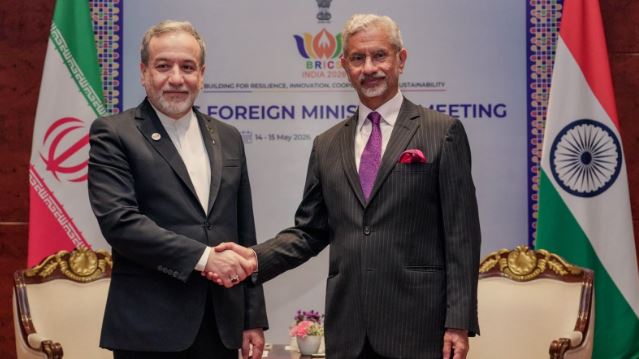
New Delhi: India can play a “greater role” in bringing peace to West Asia because of its friendly ties with almost all countries in the region, Iranian Foreign Minister Abbas Araghchi said Friday, amid mounting global concern over the economic fallout of the US-Israel war on Iran.
His remarks at a press conference in New Delhi came shortly after Prime Minister Narendra Modi said in Abu Dhabi that India is ready to extend all possible support to bring peace in the region.
Araghchi was in the national capital on a three-day visit to attend a conclave of the BRICS foreign ministers hosted by India.
“I think India, with its good reputation, (India) can play a greater role in this region to help (bring) peace; to promote peace and security,” he said answering a question.
“We will appreciate any positive (and) constructive role played by India in this region,” the Iranian foreign minister said.
Araghchi severely criticised the US for starting the war with Iran and said the current negotiations between the two sides are “suffering from the lack of trust”.
“Iran has been the victim of an act of unprovoked aggression by the United States and the Israeli regime, which happened right in the middle of negotiations we had with the Americans,” he said.
“As a diplomat, I’m optimistic that a diplomatic solution can prevail, but we shouldn’t ignore the possibility of going back to a full-scale war. We, as Islamic Republic of Iran, are prepared for both scenarios,” he said.
“We are prepared to go back to fighting, and we know how to defend ourselves, and we proved that in these 40 days of war, and we are also ready for diplomacy and a diplomatic solution,” he said.
The visiting foreign minister said lack of trust is the main obstacle for a peaceful solution to the conflict.
“We have no trust for Americans. This is a fact. This is the main obstacle in the way of any diplomatic efforts. I think all of you know that we have every reason not to trust Americans, while they have no reason not to trust us.”
Araghchi also responded to a question on the Chabahar port project and hoped that New Delhi will continue its work to fully develop the key maritime transit point that will be beneficial to India as well as several other countries.
The Chabahar port is being developed by India and Iran to boost connectivity and trade ties. However, India is mulling various options after a US exemption from sanctions on the project expired.
The Iranian foreign minister also said that Tehran is ready to provide India with energy resources if the country is ready to procure them.
“India has been a customer of Iranian oil in the past. It (procurement of crude oil) has been stopped by India because of the illegal and unilateral sanctions by the US,” he said.
“We are obviously interested to continue our business in oil and energy and we are ready to sell our to India. We do understand their considerations and we do understand the consequences of the sanctions imposed by the US,” he added.
Araghchi said it for the Indian government to decide whether to restore its energy ties with Iran.
“We have no problem; it is up to the Indian government to decide but I believe that once the sanctions are lifted, we will immediately go back to the same volume of trade we had with each other before the sanctions were imposed (on Iran),” he said.
“We used to have more than USD 20 billion of trade with India. Now it is much smaller but still in billions of dollars,” he said.
The Iranian foreign minister also referred to his brief conversation with PM Modi and wide-ranging talks with External Affairs Minister S Jaishankar.
“We discussed everything including Strait of Hormuz and situation in Persian Gulf region,” he said.
“Our positions are more or less close and we have same concerns and same interests in this important region. So we continue to coordinate with our Indian colleagues,” he said.
Araghchi described the situation in the Strait of Hormuz as “very complicated”.
“We are trying to help ships to pass (the waterway) safely. Everything would go back to normal once the act of aggression is totally and completely ended,” he said.
The conflict has severely destabilised global energy markets, primarily due to Tehran’s blockade of the Strait of Hormuz — a vital transit chokepoint, through which approximately 20 per cent of the world’s total petroleum supply flows.
PTI