
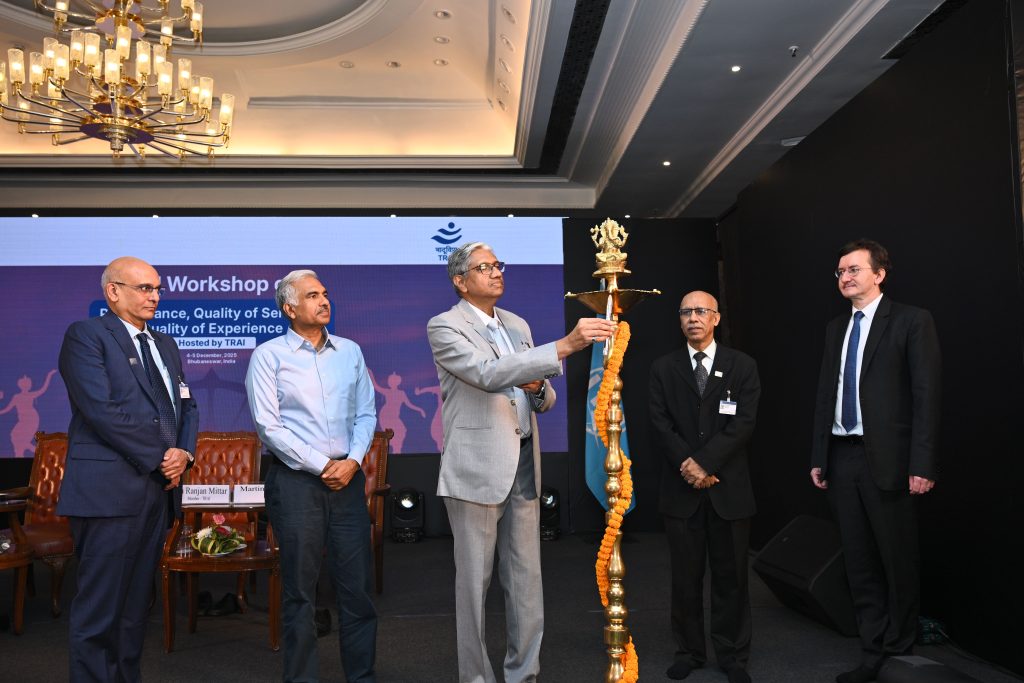
Bhubaneswar: Telecom Regulatory Authority of India (TRAI) Chairman Anil Kumar Lahoti Thursday said that India has achieved the fastest rollout of 5G services globally, supported by over 1.23 billion telecom subscribers and nearly 99 per cent 4G coverage.
He said this while addressing the inaugural session of a two-day workshop on Performance, Quality of Service (QoS) and Quality of Experience (QoE) organised by TRAI in collaboration with International Telecommunication Union (ITU) at a hotel here, Thursday. Lahoti highlighted India’s progress in building a digitally inclusive telecom ecosystem and the transformative role of connectivity in everyday life. He noted that India has achieved the fastest rollout of 5G services globally, supported by over 1.23 billion telecom subscribers and nearly 99 per cent 4G coverage. He emphasised that India continues to record high data-consumption levels while maintaining affordable tariffs that ensure broad digital access across socio-economic groups.
He highlighted TRAI’s QoS Rating Framework for Buildings (Digital Connectivity Rating) as an important initiative to enhance transparency in service-quality assessment and noted the growing need to strengthen indoor connectivity, given the significant share of data usage occurring within buildings. He further emphasised the need for deeper multilateral collaboration and called for exploring an ITU Regional Group for Asia on QoS and QoE to address challenges such as fraud prevention, cybersecurity and network interoperability. In a video message, Union Minister of State for Communications Pemmasani Chandra Sekhar emphasised India’s focus on reliable and high-quality connectivity for citizens, highlighted ongoing efforts to strengthen service quality under the Telecommunications Act, 2023, and welcomed the joint work of TRAI and ITU in advancing global standards and best practices.
Also Read: India airlifts bridge system, water units to Sri Lanka; shares disaster-response toolkit
Connectivity touches every aspect of life: CS In his special address, Chief Secretary Manoj Ahuja underscored the vital role of telecom services in public safety and disaster-response systems. Drawing from Odisha’s experience with cyclones and tsunami alerts, he emphasised the central role of telecom services in enabling inclusive growth, economic development and efficient public-service delivery. Noting that nearly every welfare system today relies on connectivity, he stressed that robust QoS and QoE systems are indispensable for timely warnings and resilient service delivery.