
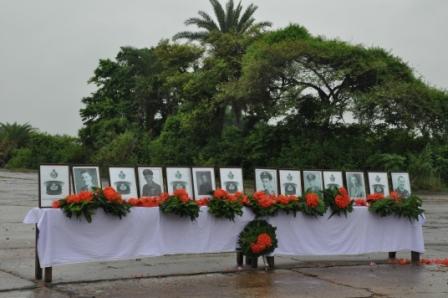
- Fourteen airmen died in the crash. Six of them were British, three American, one each from Canada, Netherlands, New Zealand, Australia and one Indian.
- Even today, seven decades after construction, one can still see the remains of the airfield, its 11,000 feet concrete runway still intact, although the buildings that once lined the edges are gone.
- The offices, hangars, mechanic sheds and plaster walled barracks with thatched roofs have been ripped down.
- Today local women dry their laundry and farmers their grain on the warm tarmac. Cows and goats hunt for weeds along the runway edges. The story of the crash and the victims is lost in history.
Rasgovindpur, (Mayurbhanj): A memorial service was held at the Amarda Road airstrip Thursday for the 14 airmen who died in a crash here July 26, 1945.
War historian Anil Dhir, Gandhian Aditya Patnaik, social activist Dr Biswajit Mohanty and staff of the Gandhi Eye Hospital at Rangamatia and locals including schoolchildren paid homage to the martyred airmen who have almost been forgotten. Wreaths were laid for each of the dead airmen.
Very few people know that Odisha had witnessed an accident in which two aircraft collided against each other and killed 14 Allied airmen during WWII. July 26, 1945 two British Royal Air Force B-24 Liberator bombers collided while flying at low altitude here.
The aircraft were based at the Amarda Road airfield and were part of a six-plane contingent from the Air Fighting Training Unit engaged in formation flying exercise.
Fourteen airmen died in the crash. Six of them were British, three American, one each from Canada, Netherlands, New Zealand, Australia and one Indian.
The airstrip had a short, secret history which has never been made public. It had the longest runway in Asia, more than 3.5 km long. The runways, taxiways, aprons, etc extended to around 60 km at that time.
Today everything is forgotten. No details of the operations that took place here between 1943 and 1945 exist even in government records. The station came into existence during WWII as a forward airfield against the Japanese troops in Burma (now Myanmar).
The large strip served its purpose well as a landing ground for planes and also as a training centre for special bombing missions.
The Amarda Road airstrip, as it was called during the war, extends across nearly 900 acres. Built in the 1940s at a cost of Rs 3 crore it was abandoned after the war. The airfield got its name from the nearby Amarda Road railway station.
Even today, seven decades after construction, one can still see the remains of the airfield, its 11,000 feet concrete runway still intact, although the buildings that once lined the edges are gone.
The offices, hangars, mechanic sheds and plaster walled barracks with thatched roofs have been ripped down.
Today local women dry their laundry and farmers their grain on the warm tarmac. Cows and goats hunt for weeds along the runway edges. The story of the crash and the victims is lost in history.
Anil Dhir has requested the governments of Odisha and West Bengal to build memorials for these airmen at Amarda Road and the crash site. He has also requested the authorities to open the sealed underground bunker which may hold relics of the period.
Aditya Patnaik said he would give ample space at the Gandhi Gurukul at the airbase for setting up a small museum which will highlight the importance of the airbase during World War II.
The setting up of a Peace Museum was mooted last year and Dhir has contacted the British, Australian, Dutch and US authorities for material to be displayed at the museum. The response has been positive.
Dhir said a book on the history of the base and the crash would be released on the next commemoration day.
Dr Biswajit Mohanty said the Odisha government should understand the importance of this historic airfield and promote it as a tourist destination. The base has huge tourism potential. Many groups from Japan, Britain, America and other countries come to visit war memorials in the North East every year.
He said every effort should be made to establish the museum. The airstrip is an important piece of history connected to World War II and has a lot of significance as it was a secret one.
Ankit Kotecha from Balasore, who is a pilot with Spicejet, too attended the memorial service.
PNN