
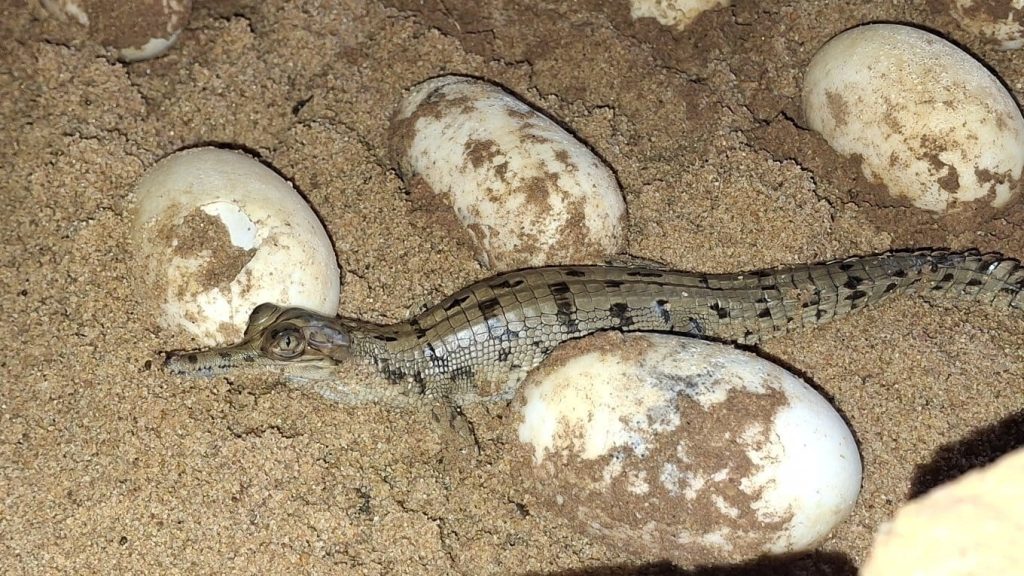
Bhubaneswar: The conservation and recovery of the critically endangered Gharial crocodile at Nandankanan Zoological Park (NZP) has emerged as a major wildlife success story, with sustained efforts leading to encouraging results both in captivity and in the wild.
To strengthen the ongoing gharial reintroduction initiative, NZP launched ‘Species Recovery of Gharial in River Mahanadi’ project in 2019. The programme focuses on habitat assessment, stakeholder participation, post-release monitoring and public awareness to restore a viable gharial population in the river system.
Since the launch of the initiative, 32 GPS/VHF-tagged gharials — including 12 males and 20 females — have been released into the Mahanadi river under a scientifically monitored rehabilitation programme. The Forest Department initiated the project in response to the declining gharial population in the river and proposed the phased release of 35 gharials bred and reared at Nandankanan to establish a sustainable wild population. Odisha remains the only state in India that is home to all three crocodilian species — Gharial, Mugger and Saltwater Crocodile. The Mahanadi river system continues to serve as an important habitat for gharials.
The programme also introduced several community-driven conservation measures, including the creation of a 10-km no-fishing zone, compensation for damaged fishing nets, incentives for the safe return of accidentally captured gharials and public outreach campaigns under the ‘Kumbhira Bandhu’ initiative. One of the most significant achievements of the programme has been the revival of natural breeding of gharials in Mahanadi after nearly four decades. According to zoo sources, a total of 160 hatchlings have been recorded within protected no-fishing zones between 2021 and 2025.
In another notable development, a released gharial laid eggs this year, resulting in the hatching of 19 young gharials at Satkosia Gorge. Nandankanan has also recorded impressive success in captive breeding. Three nests produced 14 hatchlings in 2025, while eight nests yielded 76 hatchlings in 2026. Zoo officials noted that Nan dankanan created history by achieving the world’s first successful captive breeding of gharials in 1980.
Orissa POST – Odisha’s No.1 English Daily