
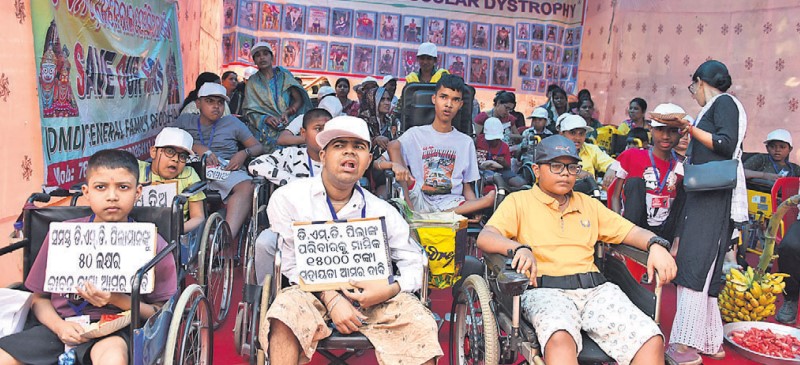
Bhubaneswar: Members of the Odisha Duchenne Muscular Dystrophy Association (ODMDA) Wednesday submitted a letter to the Health & Family Welfare Minister Mukesh Mahaling, highlighting the severe challenges faced by children with Duchenne Muscular Dystrophy (DMD) and urging immediate policy interventions, including the fulfilment of key demands.
Families of affected children, who staged a demonstration at Lower PMG here, described the condition as emotionally and physically exhausting, noting that patients require constant care throughout the day. Many children are unable to attend school, play, or lead a normal life despite their willingness, resulting in social isolation and distress.
The association president Bishnu Charan Panigrahi highlighted that access to treatment remains a major challenge. Following intervention by the High Court, AIIMS-Bhubaneswar was directed to refer patients to a Centre of Excellence in Kolkata for specialised care.
Also Read: SCB fire singes house
However, many families are unable to afford or manage travel and treatment outside the state. Despite the presence of a national policy for rare diseases, members alleged that poor implementation and limited support from the Central government have left treatment inaccessible for many patients.
Appealing to the state government for urgent relief, the association submitted several key demands, including the introduction of advanced gene therapy for DMD in India, particularly in Odisha, to ensure access to modern treatment; a one-time fi nancial assistance of Rs 1 lakh for affected children; a monthly medical allowance of Rs 15,000 for ongoing care; free genetic testing for DMD, both preand post-natal; and the development of AIIMS-Bhubaneswar as a dedicated treatment centre for muscular dystrophy.
Panigrahi stressed that without timely intervention, the condition deteriorates rapidly, imposing immense financial and emotional strain on families. They urged authorities to act promptly to improve access to treatment and ensure a dignified life for affected children. Duchenne Muscular Dystrophy (DMD) is a hereditary, progressive disorder that weakens muscles, mainly affecting young boys.
Children often lose mobility early and become wheelchair-dependent by 10–12 years, with basic daily activities like eating, drinking, and sitting becoming increasingly difficult.