
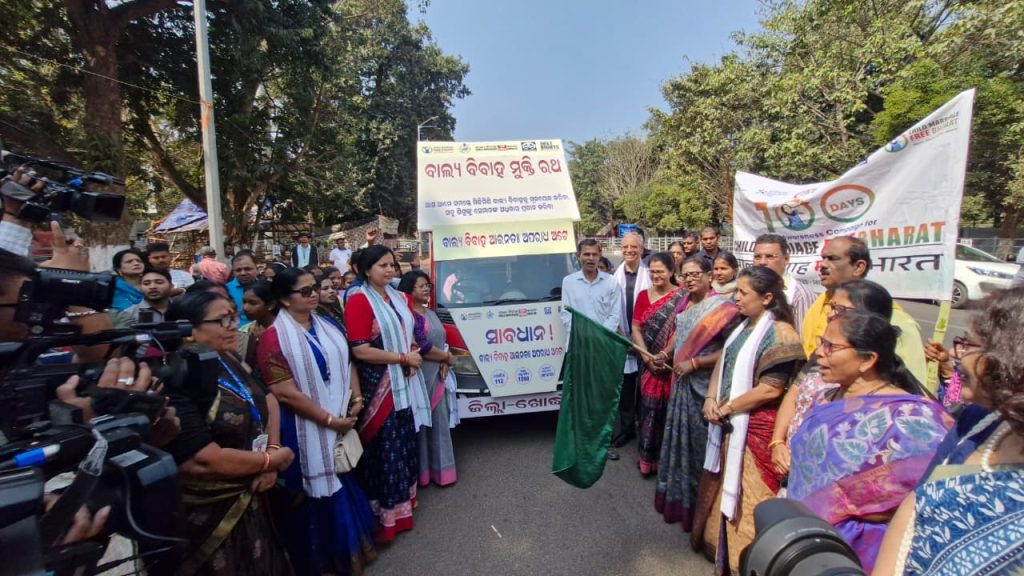
Bhubaneswar: Strengthening its campaign against child marriage, Odisha Legislative Assembly Speaker Surama Padhy Sunday flagged off the ‘Bal Vivah Mukti Rath’ from the Capital city along with Odisha State Commission for Protection of Child Rights (OSCPCR) Chairperson Babita Patra.
The Rath, carrying strong awareness messages and a public pledge wall, will travel across villages and towns in Odisha till March 8, spreading awareness against child marriage as part of the Central government’s 100- day intensive nationwide campaign.
The initiative is led by Just Rights for Children (JRC) in partnership with Ruchika Social Service Organisation.
Also Read: OSCPCR asks cops to submit report
Designed to reach the most remote and marginalised communities, the campaign will use four-wheelers on major roads, while motorcycle and cycle caravans will cover areas with poor connectivity.
Messages will be amplified through loudspeakers, posters, nukkad nataks, cultural programmes and survivors’ stories.
Reaffirming the government’s commitment, Padhy said the state had taken proactive measures, including appointing Panchayat Executive Officers and hostel wardens as Child Marriage Prohibition Officers, and designating school headmasters as Child Marriage Information Officers.
She also assured that the issue would be taken up for detailed discussion in the Legislative Assembly.
Sharing her views, Patra praised the collaboration between the government and civil society, calling it a “whole-of-society approach” essential to ending child marriage.
Women and Child Development Additional Secretary Sumitra Pattanaik was also present on the occasion and signed the pledge.
Odisha has also rolled out the ‘Mukhyamantri Kanya Bibaha Yojana’, under which eligible couples receive Rs 75,000 to promote legal-age marriages.
The scheme has gained traction, with Chief Minister Mohan Charan Majhi recently solemnising 201 marriages.
According to NFHS-5, while Odisha’s child marriage rate of 20.5 per cent is below the national average, several districts continue to record prevalence above 30 per cent, underlining the need for sustained awareness and community engagement.