

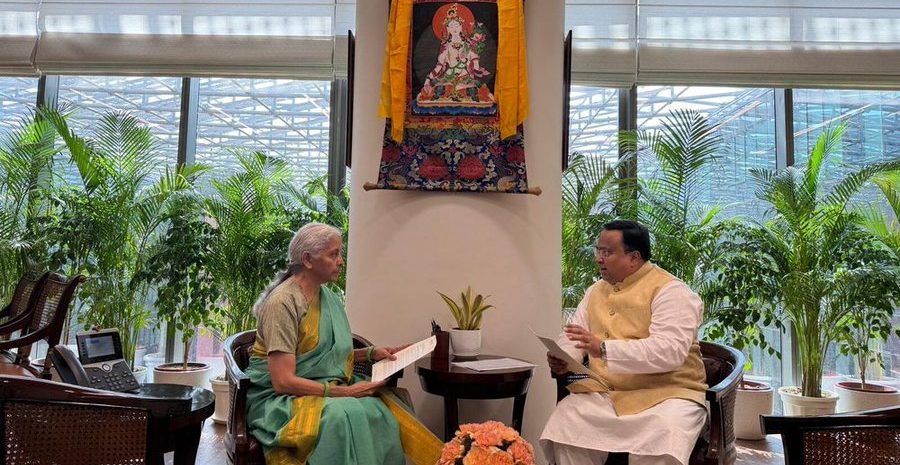
New Delhi/Bhubaneswar: BJD MP Sasmit Patra Wednesday met Union Finance Minister (FM) Nirmala Sitharaman and urged the initiation of structured deliberations on bringing petrol and diesel under the Goods and Services Tax (GST) framework.
In his detailed representation to Sitharaman, Patra emphasised that the constitutional framework under Article 279A(5) already envisages the eventual inclusion of petroleum products within GST through the recommendation of the GST Council.
He noted that although the matter had previously been deliberated upon by the GST Council following directions from the Kerala High Court, prevailing economic conditions now warranted a fresh, pragmatic and consultative reconsideration of the issue.
“I request your good office to kindly place the issue of inclusion of petrol and diesel under GST as an agenda item in the forthcoming GST Council meeting and initiate structured consultations with all states towards evolving a practical and fiscally balanced framework,” Patra said in his letter to Sitharaman.
The Rajya Sabha MP also called for the constitution of a technical and fiscal working group to examine calibrated implementation models and facilitate a broad-based national consensus on the phased integration of petroleum products into the GST architecture.
“I remain confident that under your leadership, the GST Council can undertake a balanced, consultative and forward-looking deliberation on this important national issue in the larger interest of citizens, states, industry, agriculture and the Indian economy,” he said.
Patra said fuel prices directly impact inflation, transportation and logistics costs, agricultural input costs, MSME operating expenditure, and household consumption patterns across the country.
He underlined that interstate disparities in VAT structures continue to dilute the objective of tax harmonisation and market integration envisaged under GST.
Drawing attention to Odisha’s economic profile as a major mining, industrial and logistics-intensive state, Patra observed that the calibrated inclusion of petrol and diesel under GST could significantly reduce freight and supply-chain costs, improve industrial competitiveness, and provide substantial economic relief to ordinary citizens, farmers, transport operators and MSMEs.
At the same time, he acknowledged the legitimate concerns of states regarding revenue stability arising from petroleum taxation and therefore advocated a balanced and phased framework rather than immediate, unconditional inclusion.
He proposed that the GST Council consider a calibrated GST slab structure, transitional compensation support for states, a limited revenue-protection cess mechanism, and a formula-based fiscal stabilisation framework during the transition period.