
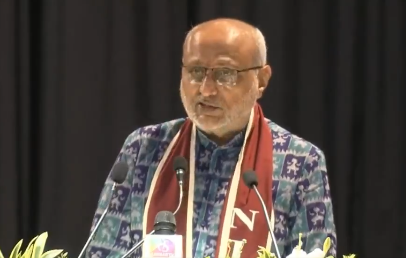
Bhubaneswar: Vice President C P Radhakrishnan Thursday said science must not only generate knowledge but also guide policy and ensure sustainability, with the world facing unprecedented opportunities and complex challenges in the present times.
Addressing the 15th graduation ceremony of the National Institute of Science Education and Research (NISER), Bhubaneswar, the Vice President observed that the world today faces unprecedented opportunities and complex challenges, including climate change, emerging diseases and rapid advances in artificial intelligence, quantum computing and advanced materials.
“In such a scenario, science must not only generate knowledge but also guide policy and ensure sustainability,” he stated.
For a country like India, with its demographic strength and developmental aspirations, scientific capability is not optional but foundational to achieving the vision of ‘Viksit Bharat 2047’, Radhakrishnan said.
Calling for greater interdisciplinary collaboration, he said contemporary challenges cannot be addressed within the boundaries of a single discipline.
He urged the graduating students to nurture curiosity, uphold integrity, embrace challenges and use their knowledge for the larger good of society.
He remarked that science is not only about finding answers but also about asking the right questions.
Highlighting India’s growing stature in science and innovation, the Vice President said the country’s achievements in space missions, vaccine development, digital public infrastructure and renewable energy have earned it global recognition.
He urged the graduates to balance ambition with responsibility and progress with compassion, adding that their research, ideas and integrity would shape the future of society.
Paying tributes to Homi Jehangir Bhabha, Radhakrishnan said the scientist’s death was a major setback for the country’s atomic research.
However, India emerged stronger from that tragedy, and today has become one of the strongest and boldest nations in the field of atomic research, he added.
Describing NISER as an institution that embodies India’s aspirations in science, innovation and intellectual leadership, he noted that the institute has emerged as a premier centre for scientific education and research and has made significant contributions to building a highly skilled scientific workforce for the country.
Union Minister for Earth Sciences Jitendra Singh said India’s nuclear programme has entered a new phase of growth under the leadership of Prime Minister Narendra Modi, while urging young scientists to carry forward the scientific legacy envisioned by Homi Bhabha.
Referring to recent milestones in the country’s nuclear energy programme, Singh said India has entered the second stage of its nuclear programme with the development of the country’s first Prototype Fast Breeder Reactor, an achievement that reflects the maturity of India’s indigenous scientific capabilities and strengthens the country’s long-term energy security.
He said India currently has an installed nuclear power generation capacity of 8,780 MW and has set an ambitious target of expanding this capacity to 22,380 MW by 2032.
Singh said the expansion reflects the country’s determination to ensure energy security while pursuing clean and sustainable sources of power.
Referring to the Union Budget, he said the government has announced the development of four Rare Earth Corridors, including one in Odisha, while the remaining three will be established in Tamil Nadu, Andhra Pradesh and Kerala.
These initiatives will significantly strengthen India’s strategic mineral ecosystem and support emerging technologies of the future, he added.
Odisha Governor Hari Babu Kambhampati, Chief Minister Mohan Charan Majhi and Union Education Minister Dharmendra Pradhan also attended the programme.
After completion of his one-day official visit to Odisha, the Vice President returned to New Delhi.