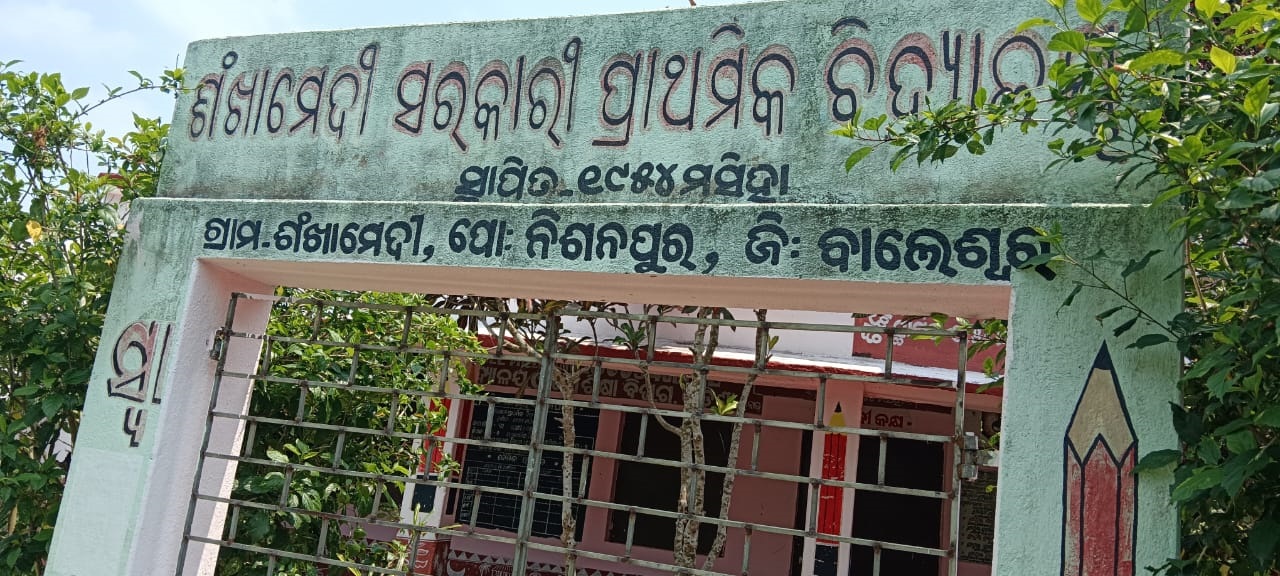
Bhograi: A boycott of the ongoing Special Intensive Revision (SIR) exercise by residents of Sankhamedi village in Balasore district has brought renewed attention to a decades-old border dispute between Odisha and West Bengal.
The development has triggered concern among local intellectuals and civil society members, who fear that continued administrative neglect could eventually see the village disappear from Odisha’s map.


The incident comes when Odisha is embroiled in a bitter border dispute with Andhra Pradesh.
The controversy came to light after a Booth Level Officer (BLO) Sumati Majhi visited the village to conduct voter verification under the SIR exercise.
Residents reportedly refused to participate, claiming that despite repeated appeals to successive Odisha governments over livelihood, education and administrative issues, their concerns had remained unresolved.
Some villagers said they had already completed electoral enrolment formalities in neighbouring West Bengal and would not fill out Odisha’s SIR forms.
Unable to complete the survey, the BLO returned and informed the Bhograi tehsildar, setting off discussions in administrative and political circles.
Historically recognised as an Odia-speaking village, Sankhamedi has remained at the centre of a long-standing jurisdictional tussle between Odisha and West Bengal.
As Odisha completes 89 years of its historic journey as a separate linguistic state, the plight of Sankhamedi has once again come under focus.
Many residents and intellectuals believe the village has, in a way, been gradually absorbed into the administrative fold of neighbouring West Bengal.
Odisha collected revenue from the village from 1927 until 1980, but discontinued the practice in the late 1970s for various reasons, creating an administrative vacuum that continues to affect the village.
Since then, Sankhamedi has continued to face administrative ambiguity, with residents receiving benefits from both states.
While Odisha has established a primary school, constructed roads and provided electricity, drinking water, toilets and ration cards, West Bengal has also extended housing and other welfare benefits to residents.
Students continue to study in Odia under Odia-speaking teachers, reflecting the village’s deep linguistic and cultural ties with Odisha.
Despite these facilities, villagers allege that the absence of clear revenue administration has deprived many students of caste certificates and other official documents required for higher education and government benefits.
Residents say such long-pending issues have left them feeling neglected and uncertain about their future. As Odisha celebrates 89 years since its formation as the country’s fi rst state created on the basis of language, the situation in Sankhamedi has assumed greater significance.
Intellectuals and social activists argue that the state’s linguistic heritage and territorial identity must be protected through stronger engagement with border communities.
They warn that if the concerns of residents remain unresolved, Odisha risks gradually losing its administrative hold over a village that has historically been part of its cultural landscape.
Bhograi Tehsildar Suryakanta Nayak said some residents had reportedly enrolled themselves in West Bengal’s electoral process and that any duplicate voter registrations would be dealt with as per election rules.
Bhograi MLA Goutam Buddha Das described the development as unfortunate, noting that various welfare measures had been extended to the village over the years. For many observers, the episode is not merely about voter enrolment.
It reflects deeper questions of governance, identity and belonging in a border region where residents continue to live between two administrative systems.
As the debate intensifies, Sankhamedi has once again emerged as a symbol of the challenges facing Odisha’s frontier villages and the urgent need for a lasting solution.