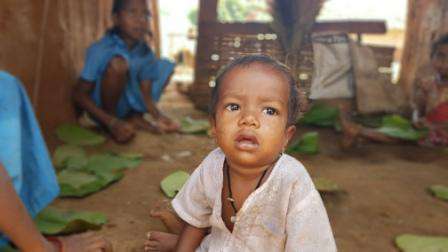
Nagada: About two years have passed since a series of malnourishment deaths of Juang tribal children were reported from this village. Even today, numerous children here face the threat of malnourishment-related ailments.
Children here suffer from anaemia and stunting, besides a recently reported ‘mysterious disease’ that leads to swollen abdomens and limbs. While the departments of Health and Women and Child Welfare are trying to paint a rosy picture, ground realities are quite different.
A recent visit to Nagada revealed several children are still affected by conditions such as stunting and anaemia. What is worse is that most villagers still abhor taking the assistance of doctors or visiting hospitals to get medical attention for their ailing children. They only rely on age-old healing practices or rituals to appease Gods.
“Whenever any child falls ill, we seldom contact a doctor right away. First we conduct ‘kukura pooja’, which involves the sacrifice of a hen to appease the Gods, to help the child heal. Approaching doctors is our last option,” Chaita Pada, a 32-year-old resident of Nagada, said.
Many others in the village are similarly reluctant to take their children to hospitals and still rely on traditional devises to cure diseases.
When children in the village came down with the ‘mysterious disease’ that caused swelling of the abdomen and limbs over the past few months, many were referred to tertiary care centres such as Shishu Bhavan in Cuttack. But the parents left the hospitals with their ill kids once they witnessed the deaths and serious ailments of other child patients in these hospitals. There are many in the village who refuse to take pills prescribed by doctors despite being gravely ill.
A silver lining in the scenario though is that the kind of fatal malnourishment that claimed 22 children from the village in 2016 has ebbed as a result of government interventions. But the tribe remains reluctant to adopt modern interventions, which is making younger kids vulnerable to other diseases.
“Their eating habits have improved over the last two years, as they now consume vegetables, unlike earlier when they ate only rice and salt. Now anganwadis are also active in the village, but the health of the children is not fully assured. There are many incomplete tasks to undertake,” Bibhudatta Jena, the coordinator of Trikil India, an NGO working in the village, said.
2 yrs after outrage, Nagada kids still vulnerable