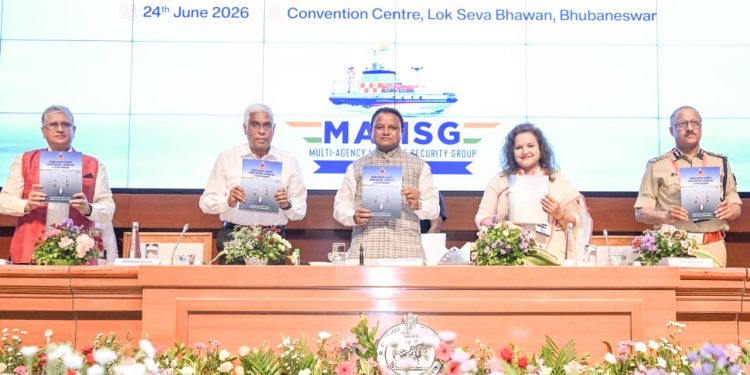
Bhubaneswar: Emphasising the use of AI and other advanced technologies to safeguard the country’s coastline, Odisha Chief Minister Mohan Charan Majhi Wednesday said maritime security is crucial not only for national security but also for economic development and the livelihoods of millions dependent on the sea.
Addressing the inaugural session of the 14th Multi-Agency Maritime Security Group (Policy) meeting here, being held outside New Delhi for the first time, Majhi said, “The use of AI, unmanned systems and modern monitoring networks in the field of maritime security is the need of the hour.”


He said the installation of ‘NABHMITRA’ transponders in fishing boats and initiatives such as the Coastal Vibrant Village Programme were important steps towards strengthening maritime security.
The chief minister lauded the efforts of the Indian Navy, Coast Guard, Odisha Police and other agencies engaged in maritime border security.
Stating that the 21st century is widely regarded as the Indo-Pacific century, Majhi said India is emerging as a major maritime power.
Also Read : Seas are gateways to growth, says Odisha CM at maritime security meet
“This high-level national meeting is being held in Odisha for the first time. It reflects Prime Minister Narendra Modi’s commitment to cooperative federalism and the country’s federal structure,” he said.
Describing seas, ports, fisheries and the blue economy as vital national assets, Majhi said their protection was essential.
“Their protection is not only essential for the security of the country, but also for economic development and the well-being of the livelihoods of millions of coastal people who depend on the sea,” he said.
He said maritime security was no longer confined to traditional law-and-order issues and now encompassed challenges such as protection of critical infrastructure, cybersecurity, disaster management, environmental conservation and maritime awareness.
Highlighting Odisha’s rich maritime heritage, chief minister said the state’s 575-km-long coastline along Bay of Bengal was a valuable asset.
Recalling the maritime links of ancient Kalinga with countries in Southeast Asia, he said the Bali Jatra festival continued to symbolise those historic trade and cultural ties.
Majhi said Odisha has been playing a significant role in India’s maritime growth story.
“To further strengthen the state’s maritime strategic position, a deep-sea port is being developed at Ganjam and a shipbuilding cluster is coming up near Paradip,” he said.
The chief minister said the state government fully supports the Centre’s initiatives, including SAGAR (Security and Growth for All in the Region), the Act East Policy, BIMSTEC and the Coastal Security Scheme Phase-III.
Addressing the gathering, National Maritime Security Coordinator (NMSC) and retired Vice Admiral Biswajit Dasgupta said maritime security required a comprehensive and well-defined framework.
“It is very difficult to find a specific model for maritime security. A well-thought-out strategic framework needs to be developed based on various models,” he said.
Dasgupta said the National Maritime Security Office in New Delhi was undertaking several initiatives to create awareness and provide guidance to coastal states on maritime security issues.
Chief Secretary Anu Garg said maritime security should not be viewed solely through a military or security lens.
She urged the senior officers present at the conference to give equal importance to both the security and development of not only the main coastal areas, but also the islands in the sea.
The conference was also attended by CM’s advisor Prakash Mishra, DGP YB Khurania and others.