
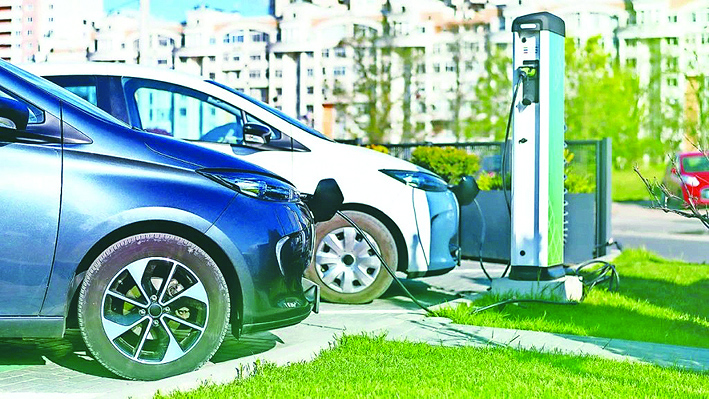
New Delhi: In a far-reaching move, the Delhi government on Saturday proposed a hugely reformist electric vehicle policy, which includes zero registration fee and road tax on EVs priced up to 30 lakh, massive proliferation of charging stations and a Rs 1 lakh incentive on purchase of new EVs upon scrapping old vehicles.
The draft policy, which also requires at least 10 per cent of school buses to be electrically powered within two years, is largely aimed at reducing vehicular emissions, which have made Delhi one of the most polluted cities in the world.
The government has proposed a 100 per cent exemption on road tax and registration fees for electric cars with an ex-showroom price of up to Rs 30 lakh, valid till March 31, 2030.
These segments, known for high daily usage, are seen as key contributors to Delhi’s pollution.
Cars priced above Rs 30 lakh will not receive such benefits, while strong hybrid vehicles will be eligible for a 50 per cent tax exemption, signalling a transitional approach.
Recognising that two-wheelers constitute the bulk of Delhi’s vehicle population, the policy offers declining incentives to encourage early adoption
A Delhi resident buying an electric two-wheeler priced up to Rs 2.25 lakh (ex-showroom) will receive an incentive of Rs 10,000 per kilowatt-hour (kWh), up to a maximum of Rs 30,000 in the first year from the date of notification of the policy.
“In the second year, buyers will receive Rs 6,600 per kWh, capped at Rs 20,000, while in the third year, the incentive will drop to Rs 3,300 per kWh, up to a maximum of Rs 10,000,” according to the draft policy.
Meanwhile, only electric two-wheelers will be registered in Delhi from April 1, 2028.
Residents of Delhi will get up to Rs 1 lakh as a scrapping incentive on purchasing a new electric car in exchange for scrapping their old BS-IV and older vehicles. The benefit is limited to the first 1 lakh eligible applicants.
Petrol and diesel vehicles will no longer be added to delivery and ride aggregator fleets in Delhi from this year, while only electric auto-rickshaws will be registered from next year.
Chief Minister Rekha Gupta said the draft policy, proposed to be in force until March 31, 2030, outlines a comprehensive framework to promote clean and sustainable transport in the city.
“The proposed Delhi EV Draft Policy 2026 is a significant step towards establishing a clean, accessible and sustainable transport system in the capital,” she said.
“Extensive financial incentives, tax exemptions, mandatory provisions and infrastructure development have been emphasised to promote electric vehicles in Delhi,” the chief minister added.
The Delhi government has earmarked a total outlay of Rs 3,954.25 crore for the policy. This includes Rs 1,236.25 crore for purchase incentives, Rs 1,718 crore for scrapping incentives and Rs 1,000 crore for charging infrastructure development, she added.
Transport and vehicular emissions remain the single largest contributor to Delhi’s local PM2.5 burden, accounting for nearly half of the pollution load.
During last year’s peak winter pollution period, vehicles contributed about 46 per cent to 53 per cent of the city’s local PM2.5 levels, according to a report by the Centre for Science and Environment released on December 31 last year.
Sunil Dahiya, founder and lead analyst at Envirocatalyst, said the Delhi EV Policy, 2026-2030, anchors the right to clean air directly to the constitutional right to life.
“By addressing vehicular emissions, a primary pollution source, the government is finally ensuring the transport sector takes ownership of its responsibility to provide a livable environment,” Dahiya told PTI.
An apex committee chaired by the transport minister will oversee implementation and EV fund management, while a high-level committee headed by the chief secretary will coordinate among departments.
The Delhi government unveiled its draft Electric Vehicle (EV) Policy, 2026-2030, placing financial incentives at the centre of an ambitious push to accelerate electric mobility and combat worsening air pollution in the capital.
Keeping in mind vehicular pollution, the policy proposes a mix of subsidies, tax exemptions and scrappage incentives aimed at making electric vehicles more affordable.
Electric three-wheelers and goods carriers are also covered under the incentives. This includes an e-auto subsidy of Rs 50,000 in the first year, Rs 40,000 in the second year, and Rs 30,000 in the third year. For e-goods vehicles (N1 category), incentives up to Rs 1 lakh will be provided in the first year from the date of notification.
Under the new EV policy, the Delhi government may also mandate 30 per cent of all school buses shift to electric by the end of March 2030.
According to the draft policy, departments, autonomous bodies and civic agencies, including the Municipal Corporation of Delhi, the New Delhi Municipal Council and the Delhi Cantonment Board, will have to ensure that new civil projects are EV-charging-ready, with adequate electrical capacity for installing charging infrastructure.
The policy proposes a “gradual decline in subsidies” to encourage early adoption and reduce long-term fiscal burden.
While financial benefits form a major component of the policy, it also focuses on enabling infrastructure, including the expansion of the charging network across Delhi, promotion of battery swapping, dedicated EV fund for financing, battery recycling and traceability systems.
The government aims to create a “comprehensive EV ecosystem” alongside consumer incentives.
To support infrastructure, the Delhi Transco Limited has been designated as the nodal agency for the planning and implementation of charging and battery swapping networks.
A dedicated digital portal will be developed to streamline approvals, monitoring and operations.