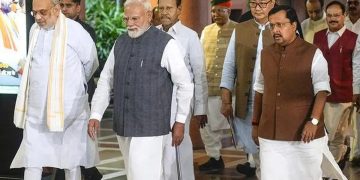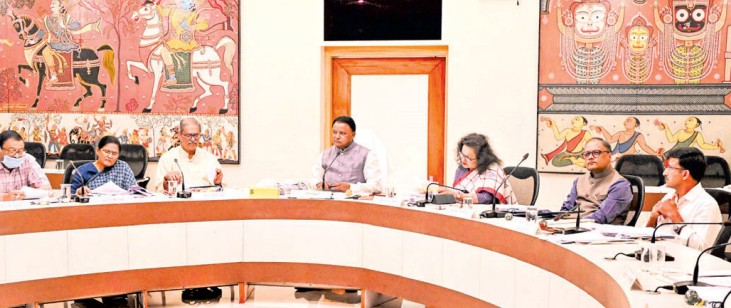
Bhubaneswar: The Odisha Cabinet headed by CM Mohan Charan Majhi, has taken two major decisions aimed at strengthening social justice in education and enhancing food security across the state.
Addressing the media, Majhi announced revised reservation provisions for higher education institutions and the introduction of a new food distribution scheme, “Mukhyamantri Annapurna Yojana,” for the financial year 2026-27.

The Cabinet approved the launch of the “Mukhyamantri Annapurna Yojana” to provide additional rice to beneficiaries under the National Food Security Act (NFSA) and State Food Security Scheme (SFSS). Under the scheme, beneficiaries will receive an additional 5 kilograms of rice per person per month free of cost, over and above their regular entitlement.
Currently, 97.97 lakh families covering 3.22 crore individuals benefit under NFSA, while 2.98 lakh families with 5.62 lakh members are covered under SFSS. In total, about one crore families comprising 3.28 crore people will benefit from the new scheme.
The state will distribute an average of 1.64 lakh tonne of rice monthly, amounting to 19.71 lakh tonne annually. The Cabinet approved an estimated monthly expenditure of 734 crore, with an annual outlay of 8,813 crore for the 2026-27 financial year. Under the Cabinet decision, reservations in admission to medical, engineering and other higher and technical education courses have been revised.
Scheduled Tribes (ST) will receive 22.5 per cent reservation, Scheduled Castes (SC) 16.25 per cent, and Socially and Educationally Backward Classes (SEBC) 11.25 per cent. The revised policy will apply to all state universities, affiliated colleges, ITIs, polytechnics and institutions offering courses in engineering, technology, management, medicine, nursing, pharmacy, agriculture, architecture and other professional disciplines at undergraduate and postgraduate levels.
The Chief Minister noted that despite ST and SC populations being over 22 per cent and 17 per cent respectively, reservation in professional courses had remained at 12 per cent for STs and 8 per cent for SCs for a long period, while SEBC students had no reservation. The new policy aims to address this disparity and strengthen educational empowerment.
With the revised system, ST medical seats will increase from 290 to 545, SC seats from 193 to 393, and 272 seats will be reserved for SEBC students. In engineering courses, ST seats will rise from 5,349 to 10,030, SC seats from 3,566 to 7,244, while 5,015 seats will be reserved for SEBC students. Majhi stated that the initiative will further strengthen food security, while the reservation reform will empower students from disadvantaged communities and contribute to building a more inclusive and prosperous Odisha.
The Cabinet also approved the ‘Comprehensive Flood Management Scheme’ with an outlay of Rs 2781 crore to be spent over a five-year period. The Cabinet approved the Mukhyamantri Hastatanta Bikasha Yojana for the holistic development of handloom sector in the state.
A proposal for expenditure in connection with Bhubaneswar Metro Rail Project also got the Cabinet’s nod. Besides, the Cabinet approved the introduction of Odisha Industries Service (Validation of Appointment of Assistant Managers and Assistant Directors) (Amendment) Bill, 2026 for amendment of Odisha Service (Validation of Appointment of Assistant Managers and Assistant Directors) Act, 2025 (Odisha Act 3 of 2017). The proposal for revival of Badamba Cooperative Sugar Industries Limited also got the Cabinet’s nod.
The Cabinet gave its approval to a proposal for redevelopment of VSSUT at Burla. The state government will spend Rs 929.96 crore for the initial phase of the project. Apart from this, a proposal for procurement of 79,033 smartphones under POSHAN Abhiyan was among the 16 proposals approved by the Cabinet.