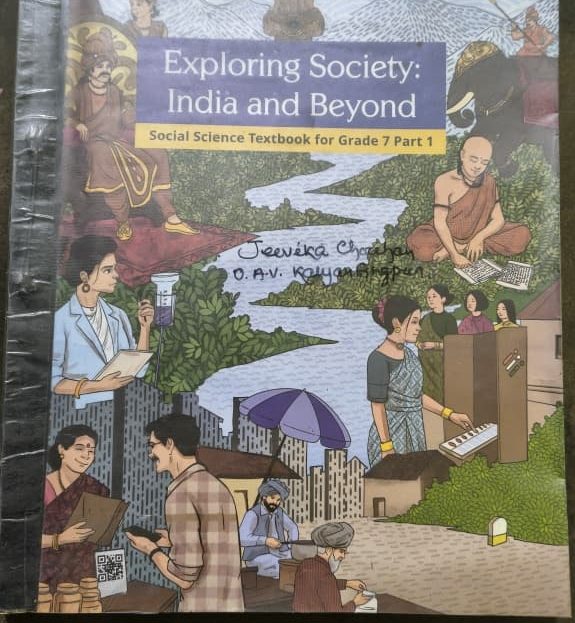
Rayagada/Kalyansinghpur: An error has been identified in the new Class VII Social Science textbook for the 2025–26 academic year prescribed by the National Council of Educational Research and Training (NCERT).
The book titled “Exploring Society: India and Beyond” reportedly misidentifies the location of the Niyamgiri Hills as Jharkhand.
The inaccuracy has raised concerns among educators and parents over the credibility of information presented in the curriculum.
In the book’s Chapter 8 titled “How Land Becomes Sacred,” the text states that the Niyamgiri Hills are located in Jharkhand and describes their religious and spiritual significance to the Dongria Kondh community.
The chapter mentions that the community believes their deity, Niyam Raja, resides in the hills and provides them with food and other necessities for their sustenance.
It also notes that cutting trees in the hills is prohibited and considered disrespectful to their deity.
The discrepancy came to light when a private tutor in Kalyansinghpur block of Rayagada district noticed the error while teaching a Class VII student of an Odisha Adarsha Vidyalaya (OAV).
He pointed out that the Niyamgiri Hills are actually located in the Rayagada district of Odisha and are home to the primitive Dongria Kondh tribe, particularly in the Kalyansinghpur block. The hills are a distinct identity of the region.
The tutor expressed concern that such inaccuracies could adversely affect students’ learning and called for immediate correction of the mistake.
When contacted, Kalyansinghpur OAV Principal Sangeeta Palaka acknowledged the error and said the department had already been informed of the necessary correction.
Notably, the state government has established OAVs in various districts of the state to promote and provide free quality education.
The school’s aimis to strengthen students, especially from rural areas, by providing education in English medium by inculcating the 21st century learning skills through a holistic and integral approach for their physical and aesthetic development apart from academic learning.