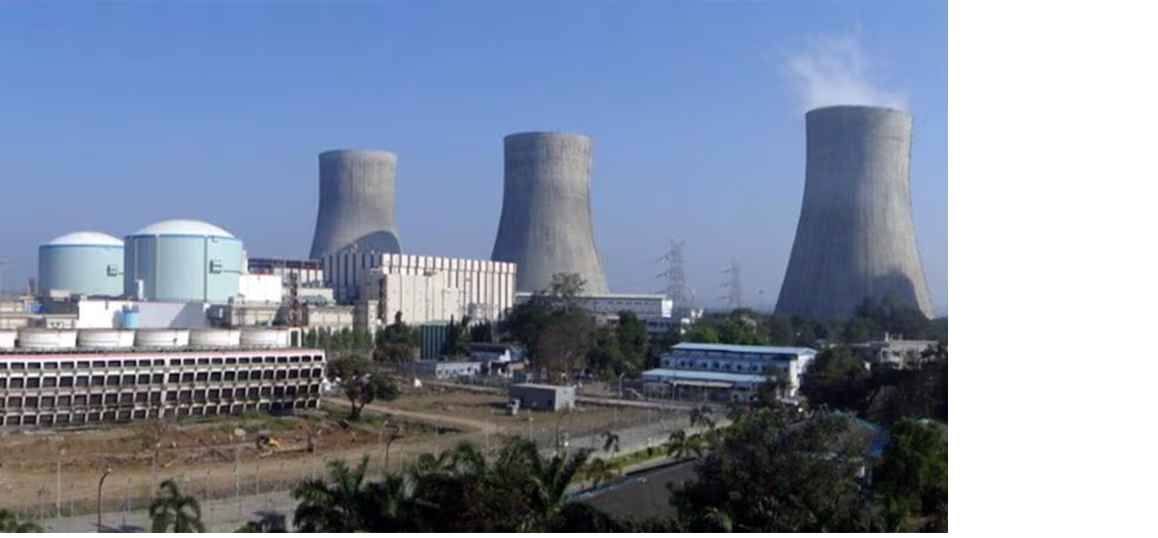
The recent criticality of India’s Prototype Fast Breeder Reactor (PFBR) in early April marked a long-awaited milestone. It signalled India’s operational entry into the second stage of the three-stage nuclear programme envisioned by Homi Jehangir Bhabha in the 1950s. The achievement is immense: India has, despite decades of technology denial, built a commercial-scale FBR entirely on the strength of its own scientists and engineers, persisting with it in the face of scepticism and uncertainty.
But we must look past the hype that fills social media and even mainstream media. The PFBR is not the destination. It is, in fact, the point at which the programme enters its most difficult phase: the science and engineering have been proven; now the question is can India build industrial scale fast enough for the programme to remain relevant to the country’s rising energy needs and the global energy transition?


The logic of Bhabha’s programme is often presented as a neat progression: Stage 1 uranium reactors produce plutonium as a byproduct; Stage 2 FBRs use that plutonium to “breed” more fissile material; and Stage 3 runs on a self-sustaining thorium cycle. The bottleneck today is not the reactor; it is the fissile inventory — the plutonium.
Going by estimates and recent statements of senior officials of the Department of Atomic Energy (DAE), India has enough separated plutonium to start and run the PFBR and two more 500 MWe reactors, FBR 1 and 2. If final approvals and funding are given today, and all goes well with construction, we should expect these units to come online by about 2035. However, that is where the shelf-ready fuel supply ends.
While breeders are named for their ability to produce more fuel than they consume, the rate depends on the breeding ratio. For the PFBR and FBR 1&2 using Mixed Oxide (MOX) fuel, the breeding ratio is a modest 1.03 to 1.05. This results in a system doubling time — accounting for cooling, reprocessing, and refabrication into fuel — of nearly 30 years. That is, each reactor would take that long to generate enough surplus plutonium to start another unit. At this rate, the FBR programme will not scale; it will stagnate.
For the next decade and more, expansion will depend less on breeding and more on reprocessing spent fuel from India’s Stage 1 Pressurised Heavy Water Reactors (PHWRs). India has several tonnes of unseparated plutonium in its spent fuel. Bringing that material into circulation will determine the pace of FBR expansion beyond the first three reactors.
Here, the infrastructure is yet to catch up. The Integrated Nuclear Recycling Plant (INRP) at Tarapur, expected by 2028, will expand capacity, with throughput to support only another 3-4 FBRs. Meanwhile, the Fast Reactor Fuel Cycle Facility (FRFCF) at Kalpakkam, meant to reprocess FBR fuel, has been delayed until 2030. Even when operational, its capacity is designed for only the initial three reactors. Unless reprocessing capacity is expanded significantly, the next set of reactors will likely be pushed beyond 2045, and a meaningful transition to thorium will slip beyond 2060.
India does not have that kind of time. Two structural shifts have compressed the timeline. The first is the energy transition; India must expand clean energy at scale within the next two decades to meet its 2070 Net-Zero commitment, remain industrially competitive, and ensure energy security. The second is the nature of demand: the rise of AI and the hyperscale data centre model.
These centres require continuous, high-density, 24/7 power. Renewables cannot provide such power without prohibitively expensive storage. Nuclear fission remains the only source of scalable, clean, all-weather baseload power, which is why the world is returning to it.
America wants to quadruple its capacity to 400GW by 2050, and China is targeting 500GW. India has set a target of 100GW by 2047. Much of this expansion will be uranium-fuelled until at least 2040, a path that is slow, expensive, and wasteful — and, for India, potentially a strategic trap in a time of weaponised supply chains and chokepoints. India’s FBR programme is a huge advantage, but only if scaled rapidly between now and 2040. Otherwise, India will be overtaken.
Russia is advancing its Proryv (Breakthrough) project, an integrated model combining a lead-cooled breeder (Brest-OD-300) with co-located fuel facilities—similar to India’s model at Kalpakkam, but designed for export. China beat India to operationalising its first commercial-scale breeder, the CFR-600, in late 2023, with a second unit coming online this year. China has also taken the global lead on Molten Salt Reactors (MSRs) that could bypass the breeder route to thorium altogether.
Western start-ups like TerraPower, Copenhagen Atomics, and Moltex are also racing toward fast reactors and MSRs to achieve thorium usage and waste reduction. If any of these models scale first, India’s programme will face pressure to give up its path. This was evident with the PHWR programme: because it didn’t scale in time, India turned to Russian reactors in Kudankulam. The same risk exists for the FBR programme.
The constraint on India’s expansion is fissile inventory, particularly between 2035 and 2045. At present, the breeder programme depends on plutonium from a limited set of eight unsafeguarded reactors. Meanwhile, India has accumulated spent fuel from uranium imported for its safeguarded reactors. This significant amount of plutonium is lying idle because we lack safeguarded reprocessing facilities.
The solution is to separate civilian expansion from the military programme — as in the case of obtaining uranium under the India-US nuclear deal — through a dual-stream system:
Stream 1: Retain the PFBR, FBR 1 & 2, and associated fuel facilities in the unsafeguarded stream for strategic purposes.
Stream 2: Build a safeguarded stream — FBR 3 onwards, and new reprocessing and fuel fabrication facilities that tap into the plutonium in spent fuel from imported uranium.
This commercial track will allow imported uranium to fuel a rapid FBR expansion, accelerating the 100GW goal. It will also allow the introduction of thorium blankets in the 2035–2040 timeframe to build the U-233 stockpile necessary to begin the transition to thorium reactors by 2045–2050.
To hit the 2047 target and realise the thorium dream, the government must act now: mandate metallic fuel starting with FBR3 to maximise breeding ratio; accelerate INRP Tarapur to be online no later than 2028; start building safeguarded fuel cycle facilities now; and adopt fleet-mode construction; introduce thorium in FBR blankets in the 2035-2040 timeframe.
All of this requires clarity, political will and urgent decision-making. The PFBR going critical should give the Indian government the confidence to go ahead.
The writer is a senior journalist and researcher based in Bangalore. ©The Billion Press