
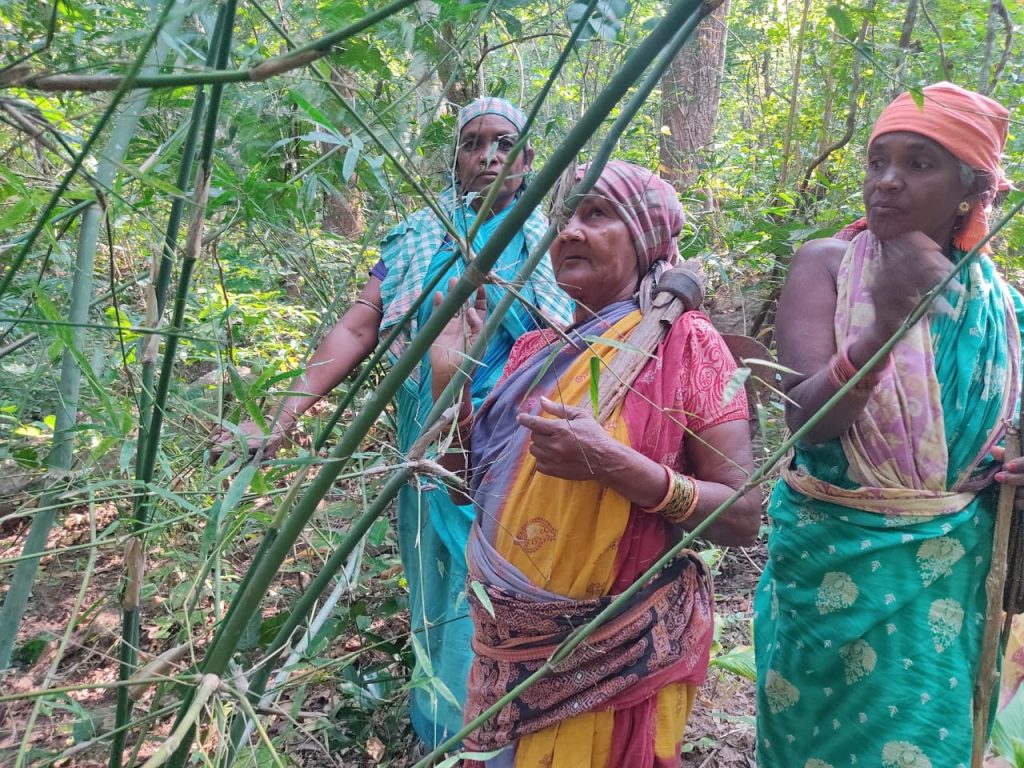
Nayagarh: A women-led initiative to protect bamboo forests has transformed a once-degraded woodland into a thriving ecosystem in Baijhari forest under Duda panchayat of Dasapalla block in Nayagarh district, while also creating sustainable livelihoods for tribal and Dalit women.
The protection of the Shinka bamboo groves has not only revived the forest cover but also restored a traditional source of income through the preparation of leaf plates made from sal and siali leaves. By 2020, the Baijhari forest had nearly vanished due to rampant exploitation.
Shinka bamboo had become scarce, forcing women to stop making leaf plates — an activity that had supported many households. Some families managed to sustain the practice by sourcing bamboo from nearby forests, but most women lost their livelihood. Faced with mounting hardship, village women came together towards the end of 2020 and resolved to restore and protect the bamboo forest.
Their collective efforts gradually yielded results. As bamboo regenerated, other plant species also began to thrive. Encouraged by the women’s commitment, men in the village also joined the effort, helping curb illegal felling, charcoal making and stone theft. With the forest slowly recovering, women resumed leaf-plate making, which has now become the mainstay of households across the village.
The initiative has provided a steady income to tribal and Dalit families and strengthened food security. Pranati Malik, a resident of Baijhari, said the village has 53 families, mostly from tribal communities and a few Dalit households. “When the bamboo forest disappeared, women lost their income completely. Protecting the bamboo helped us secure the entire forest and revive our livelihoods,” she said.
Subhadra Jani explained that Shinka bamboo is essential for stitching leaf plates. “Other bamboo varieties are not suitable for the purpose. After cutting the bamboo, we remove the outer layer, split and dry it in the sun before using it to stitch sal and siali leaf plates,” she said.
Minati Malik said the destruction of bamboo inadvertently taught the community the value of conservation. “If bamboo had not been destroyed, we might never have realised the need to protect the forest. By protecting bamboo, we protected the entire forest.
The forest now supports our survival,” she said. Residents say Shinka bamboo is a rare variety found only in select forests and is uniquely suited for leaf-plate making. Using other bamboo types is labour-intensive and leads to wastage. The Baijhari model is now being cited locally as an example of how community-led forest conservation can restore ecosystems while empowering women economically.