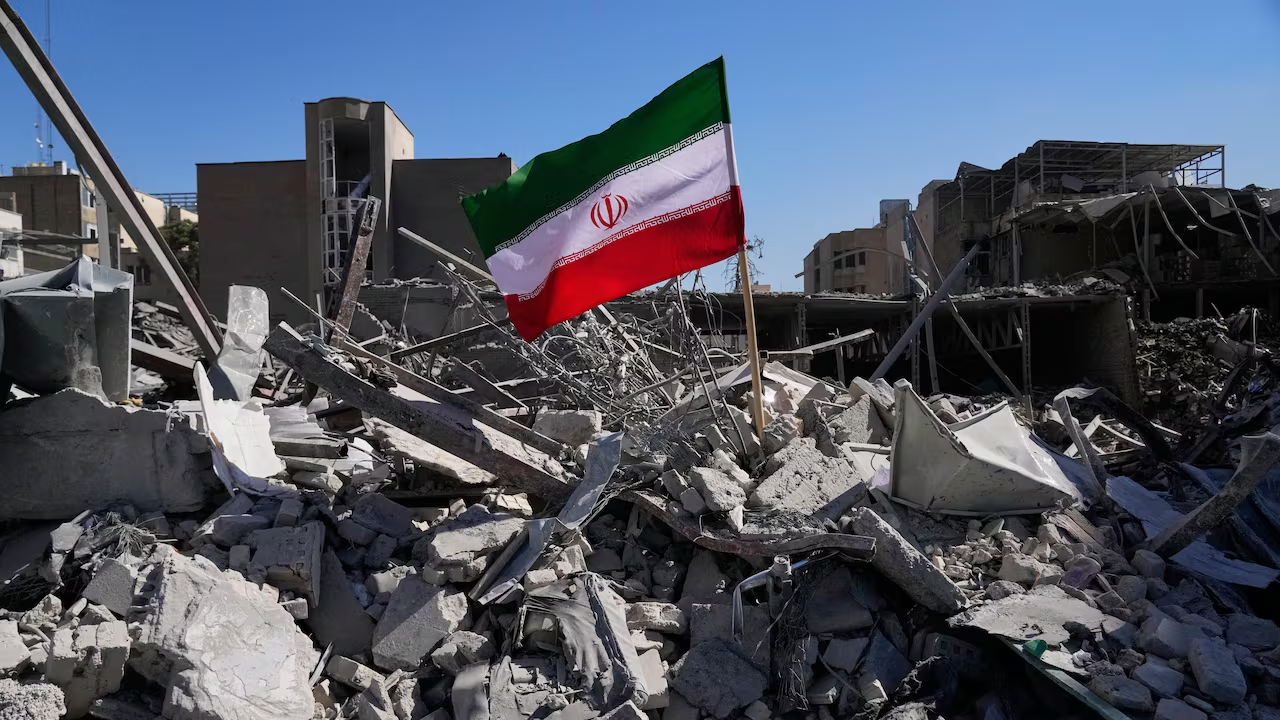
The war in West Asia, perhaps the most debilitating in over two decades, has reached its second month on an aggressive and dangerous pitch with both sides, Israel-USA and Iran, fighting an asymmetric war whose objectives have seen rapid swings with no coherence. Amidst this mad destruction and killing of humans, by now over 3000, including several expatriate Indians, and targeting of universities, nuclear, power and energy centres, the war has seen a rapid escalation and regionalisation with ramifications far beyond the Gulf. The two-week pause in hostilities announced by President Trump on 8 April comes as a respite, but it will not change the new geopolitical dynamic marked by the collapse of the international rules-based order. When the war will end is uncertain, but what is certain is that the region’s architecture will never be the same again.
The war plan devised by the Israeli PM Benjamin Ne tanyahu, that Iran, being the fountainhead of terrorism and patronising non-state actors, Hamas, Hezbollah, Houthis and the militias in Iraq and Syria, was an existential threat and had to be destroyed, found ready acceptance by the mer curial US President fresh from his adventure in Venezuela and outrageous demands to take over Greenland. The month long riots in January which had seen a mass popular upsurge quelled down with a heavy hand by the Islamic regime provided an ideal backdrop and regime change became the first declared war goal of the aggressors when in a targeted assassination Iran’s Supreme Leader Ayatollah Ali Khamenei was killed along with 40 top military and security officials and close members of his family on 28 February, the very first day of the war. The son of Mojtaba Khamenei, who was to be soon elected as the third Supreme Leader of Iran, escaped with severe injuries and has been leading the war efforts with the strong backing of the Iranian Revolutionary Guard Corps and clergy.


The plan of Israel and the USA, calling on the Iranian people to rise up and take over their government, boomeranged badly. Instead, the dastardly killings have galvanised the people to rally around the flag and support the IRGC in fighting the “enemies” of the revolution. For Iran, it has been a war of survival; the regime had to protect itself against the insidious, illegal, and totally uncalled attack on its sovereignty. Iran had been preparing for this eventuality for over 20 years, and with the experience of the 12-day war last June with Israel, backed by the USA, in savagely attacking Iranian nuclear sites, had drawn several lessons.
The unified Iranian command system changed to a decentralised command and control structure wherein all the 30 provinces formed their own militaries under separate commanders who were to fight autonomously under the overall direction of the Supreme Leader located in the Central command in Tehran. Besides, the power groupings were designed to take over if the top layer was eliminated. Secondly, having constructed elaborate underground tunnels throughout the length and breadth of the country, including the Persian Gulf coastline, they could keep their missile and drone production capability intact while launching attacks in a coordinated and escalatory manner, initially using their older missiles to deplete the enemy interceptors and air defence systems while keeping their latest technologically superior missiles and drones for later use. With the express support of two Great Powers, China and Russia, Iran has been fighting a 21st-century war against a powerful America. Iran knows it can’t defeat the America-Israel combine, but it can exact high costs on them and their allies in the region. It can endure pain and sacrifice, but in return, inflict pain too and fight till the finish.
It is a moot point that America’s war started without the authorisation of Congress or the UN, as a show of power projection by Trump, who had chosen to align completely with Netanyahu, with the objective of decimating Iran’s nuclear programme and missile and drone production capability. The powerful Jewish lobby in America had worked overtime in securing Washington’s full backing for Israel.
Geography and energy have been Iran’s biggest weapons throughout the war. With complete control over the Strait of Hormuz, the jugular vein of global energy through which over 20% of global oil and gas pass, Iran has zeroed in on the centre of gravity by attacking US bases in the region and high-value military, civilian and nuclear targets of Israel with absolute precision. With satellite support by China and Russia having provided air superiority, Iran has had an edge both on the strategic and tactical levels.
Trump has been hard-pressed to seek fresh options to continue the war, yet desperately looking for off-ramps. His statements on talks with Iran through intermediaries, while calling for boots on the ground, have shown him as vacillating and self-contradictory.
In addition, the Houthis, supported by Iran, had opened another front by launching ballistic missiles at Israel while threatening to block the Bab el-Mandeb passage to the Red Sea and Suez Canal. The two-week ceasefire, therefore, represents an abrupt but not entirely unexpected last-minute turn from the shocking position of the US that “a whole civilisation will die tonight.”
The war has been clearly Netanyahu’s doing, with Trump falling for it without thinking about its consequences. The refusal of America’s NATO allies to grant overflight or usage of American bases has been the last straw, forcing Trump to veer in favour of withdrawing from the region, with the Strait still under Iranian control. A retreat, no doubt, will reverberate in the domestic politics of America, with the “No Kings” protest having drawn more than eight million protesters all over the USA, standing up against excessive use of force by ICE agents and the war with Iran.
Faced with dire consequences to its economy and the growth story, India may seek to re-evaluate its strategic relationships with both America and Israel. That is, if India is serious in formulating a just and balanced foreign policy. Hosting both the BRICS and Quad summits, followed by a Leader’s Summit with Russia this year, India in its quest for leadership, paradoxically finds itself relegated to the sidelines today amid the most consequential developments in its near neighbourhood.
The writer is a retired diplomat and foreign policy analyst.