
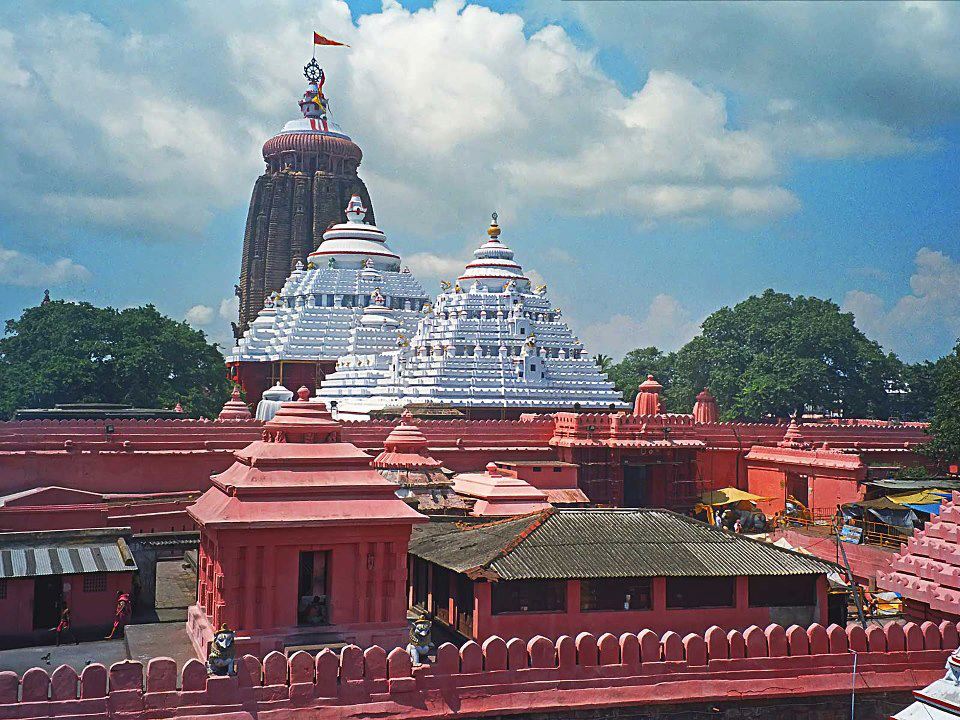
Jagannath temple is the quintessence of Kalingan architecture. Built in 12th century by Anantavarman Chodagangadev, the temple was completed by his son Anangabhimadev. Given its features and layout, the monument falls in the category of rekha deul (curvilinear tower).
Rekha order
The temple consists of four structures Vimana (sanctum sanctorum), Jagamohan (porch), Natamandir (audience hall) and Bhogamandap (hall of offerings) built in a row in an axial alignment in east-west direction. The temple faces the east. The Vimana is constructed in Pancharatha (five pagas or segments) Rekha order.
Rekha is the name given to a type of temple with a curvilinear spire. Out of the five pagas, the middle one is known as Raha, the two flanking pagas are Anurahas and the two corners are Kanika. Like a full-fledged Odisan temple, it has four-fold vertical divisions, i.e. pitha (pedestal), bada (wall), gandi (trunk) and mastaka (head).
Researchers point out that as Tantric Buddhism spread across the state between 8th and 10th centuries, architects of Jagannath temple had sub-consciously been influenced by iconographic aspects of Tantric Buddhism.
WJ Wilkinson, a foreign researcher, argued that even during Ashoka’s reign, Odisha was a Buddhist centre. A tribe known as Lohabahu (barbarians) had converted to Buddhism and built a temple with an idol of Buddha which is now worshipped as Jagannath. Lohabahu is said to have deposited Buddha relics in the precincts of the temple. Wilkinson suspected ‘Buddhist emblems vanished with the rise of Brahminism…’
Since Odisha was known as the birthplace of Tantric Buddhism, Jagannath tradition recognizes a strong connection with this.
Some researchers also referred to mention of Jagannath’s name in the Buddhist literature produced by Indrabhuti of Sambalaka (scholar and preacher of Vajrayana Buddhism) in 8th century.
Lord as Bhairava
In the tantrik cult, Jagannath is regarded as Bhairava and the Goddess Vimala as Bhairavi. They say the Bhairavi Chakra has been drawn near Ratna Simhasana or Vedi in Jagannatha temple. Jagannath was installed on this Srichakra. An image of Bhairava was also installed on the Ratna Simhasana.
Historian Harish Prusty said, ”Images of erotic couples carved on the temple are connected to Sahajyana cult of Tantric Buddhism.” Prusty observed that the Singhasan on which the deities were installed is shaped like ‘Chousathidala Padma’. “This shape of the platform represents Chousathi Yogini (Tantric Buddhism). Such symbolisms in architecture establish links with Tantric Buddhism,” he noted.
When asked about this aspect, Asit Mohanty, a researcher on Jagannath culture, said, ”I have little idea about the temple architecture. But some historians talk about the idols of lions-mounted-on-elephants. This may symbolize dominance of Brahminism on Buddhism.”
However, noted researcher Surendra Mishra says there has been no link of Tantrik Buddhism to the architecture of Puri temple. The temple structure is purely a Rekhu deul of Kalingan style, he said. He, however, pointed out that there is a Budhha statue on the temple about 30 ft from the ground in the west side.
Himansu Shekhar Rout