
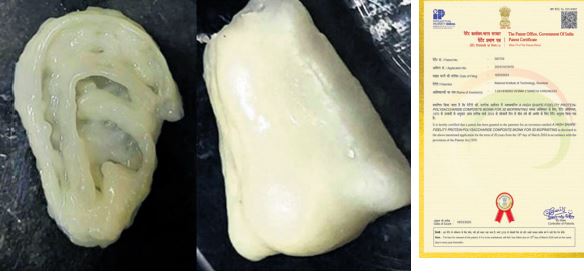
Rourkela: National Institute of Technology Rourkela has developed and patented an advanced bio-ink for 3D bioprinting of tissue-like structures, marking a significant step in regenerative medicine.
The research, led by Devendra Verma, along with research scholar Shreya Chrungoo and Tanmay Bharadwaj, addresses a key limitation in existing bio-inks — the lack of a single material combining mechanical strength, biological compatibility and printability.
Their findings, published in the International Journal of Biological Macromolecules, describe a high shape-fidelity protein–polysaccharide bioink suitable for bone and cartilage repair. The team has also secured a patent (No. 583759) for the technology.
The bio-ink was developed by blending bovine serum albumin, sodium alginate and polyelectrolyte complexes of gelatin and chitosan. This composition creates a bioactive system that supports cell growth while maintaining structural stability during and after printing.
Laboratory studies showed the material mimics the extracellular matrix of bone tissue, promoting cell adhesion and proliferation. Scaffolds containing 2% PEC-GC achieved more than 90% cell viability and demonstrated potential for bone tissue formation and collagen synthesis.
Verma said the innovation bridges the gap between print precision and biological performance, bringing clinically viable bioprinted constructs closer to reality. Chrungoo added that the bio-ink could enable patient-specific scaffolds with precise geometry and functionality.
The team plans to conduct animal studies followed by clinical validation to establish safety and efficacy.