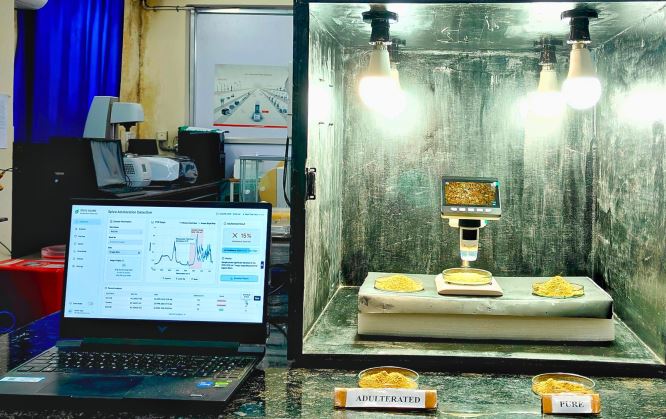
Rourkela: Researchers at the National Institute of Technology Rourkela have been granted a patent for a system that can rapidly detect and quantify adulteration in spices and other food products using infrared spectroscopy and machine learning.
The technology combines Fourier Transform Infrared (FTIR) spectroscopy with advanced algorithms to identify adulterants and measure their concentration within seconds, offering an alternative to conventional laboratory methods that are time-consuming and resource-intensive.


Unlike existing techniques that typically indicate only the presence of adulteration, the new system provides quantitative results, making it suitable for real-time use in quality control laboratories and food processing units, the institute said.
The research, published in the journal Food Chemistry, was carried out by assistant professor Sushil Kumar Singh, the late Poonam Singha and M.Tech. scholar Rishabh Goyal from the Department of Food Process Engineering. The team has also secured a patent titled “Method and System for Detecting and Quantifying Adulteration in Food Stuff.”
In one application, the system detected sawdust in coriander powder with about 92% accuracy, demonstrating its ability to identify common adulteration practices in spices. Singh said the technology could be integrated into industrial workfl ows to enable rapid screening and improve compliance with food safety standards, particularly in cost-sensitive markets such as India. The researchers said they plan to collaborate with industry partners for pilot testing and expand the system’s capability to detect a wider range of food adulterants.